

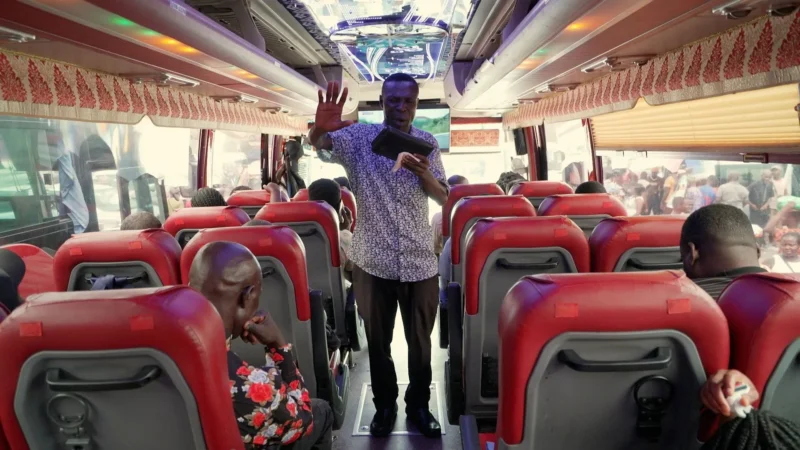


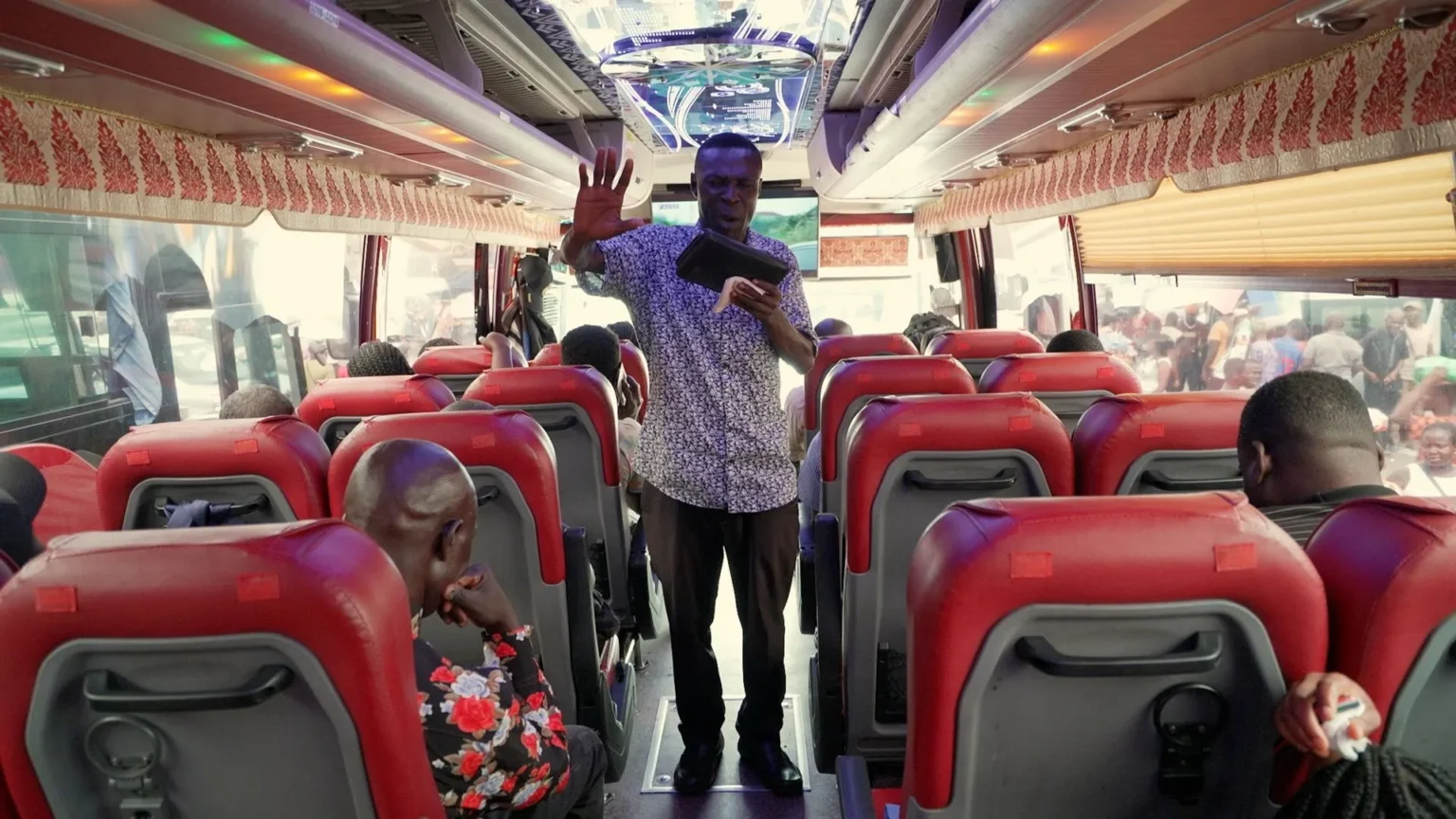
ACCRA, Ghana — Before the morning rush begins at Neoplan bus station in Ghana’s capital, praise and worship fill the air as a group of Christians gathers to pray for drivers and passengers preparing to travel across the country.
Boateng Bismark James, a 61-year-old pastor, leads 13 worshippers — nine men and four women — in prayer before they begin their evangelism.
For years, preaching on commercial buses has been a familiar part of public transport in Ghana, where Christianity is the dominant religion.
Pastors and evangelists can often be heard preaching inside long-distance buses, sometimes standing near the driver or moving through the aisle with a Bible as passengers travel for several hours.
That tradition is now facing a tougher legal environment.
Ghana’s Road Traffic Regulations, 2026 (L.I. 2519) prohibit preaching or hawking in a public or commercial vehicle while it is in motion. The offence carries a fine of between 10 and 50 penalty units, imprisonment for up to eight months, or both.
The regulations were approved by Parliament on 28 May 2026 after the Road Traffic (Amendment) Act, 2025 was assented to by President John Mahama in December 2025. The Ministry of Transport launched a nationwide sensitisation campaign in September to explain the new road-traffic framework to the public.
For Boateng, the new rules threaten both his ministry and an important source of income.
He has preached on commercial vehicles leaving Neoplan station since 2023 and says public transport provides an opportunity to reach people who may not attend church.
“I preach on commercial vehicles because not everyone is able to go to church on Sunday,” he said.
“There are a lot of passengers who need our message of salvation to repent from their sins.”
Boateng says some passengers welcome his preaching and have told him they had never heard similar messages in church.
He also says passengers sometimes give money to preachers, helping them support their families.
“I have been able to take care of my children’s education. My last-born just completed university, and half of the financial support came from money I got from preaching,” he said.
But under the new regulations, continuing to preach while a vehicle is moving could expose him to prosecution.
Boateng is calling for an exemption that would allow preachers to deliver their messages on buses before getting off as vehicles leave Accra.
The regulations do not prohibit religious preaching generally.
They specifically target conduct inside public or commercial vehicles while they are moving, with the provision treating preaching or hawking as a form of nuisance.
Authorities have framed the wider regulations as part of a road-safety reform programme covering drivers, passengers, pedestrians and commercial transport operators. The Ministry of Transport says the new framework introduces tougher penalties and stronger standards for public transport operations.
The government has also launched public education on the regulations, which cover offences ranging from speeding and drink-driving to unsafe loading and other conduct affecting road users.
The argument is that activities taking place inside moving vehicles should not compromise passengers’ comfort or create distractions in an environment where drivers need to concentrate on the road.
The new restrictions have exposed a divide among passengers.
Some travellers say they welcome the change because they want quiet during long journeys.
Chery Lokko, a passenger in her early 30s, said she preferred travelling without unsolicited preaching.
“I don’t like it because they are a nuisance,” she said.
She also complained about the volume of preaching and the possibility of preachers unintentionally spraying saliva while speaking.
Others see the practice differently.
Bernice Nartey, who was travelling to Kumasi, said preaching could offer encouragement to people experiencing difficult circumstances.
“The preaching sometimes helps people to repent,” she said.
“For instance, if someone is going through a stressful situation, the message of the pastor can give the person renewed hope.”
Her view reflects the argument from supporters of bus evangelism that public transport provides access to people who may not attend religious services.
Ghana’s Constitution protects freedom of thought, conscience and belief, including the freedom to practise and manifest a religion. It also recognises that certain rights may be subject to restrictions that are reasonably required in the interests of public safety, public order and other legitimate public interests.
That distinction is at the heart of the debate.
The new rules do not prevent pastors from preaching in churches, at religious gatherings or in other places where such activities are permitted.
Instead, they regulate preaching in a moving public or commercial vehicle.
Rev Enoch Paul Hayes, a senior pastor at the International Central Gospel Church, said he did not believe the regulation amounted to an infringement of religious freedom.
He urged fellow pastors to comply with the law and explore other ways of reaching audiences, including social media.
“There is social media as an alternative outlet, where the same message can reach thousands of people,” he said.
Ghana has attempted to regulate preaching on commercial vehicles before.
The practice was prohibited under earlier road-traffic rules, but enforcement was limited and preaching continued to be common, particularly on long-distance buses.
The 2026 regulations have increased the potential penalties, with offenders now facing up to eight months in prison, a fine of up to 50 penalty units, or both.
Also Read: Inside the controversy around Kenya’s ‘prophet’ Owuor and ‘miracle cure’ claims
The restriction does not extend in the same way to preaching at lorry parks and markets, where evangelists can still be seen using loudspeakers.
For Boateng and other travelling evangelists, the new rules present a difficult choice.
They can adapt their ministry, find alternative ways of reaching passengers, or risk prosecution by continuing to preach inside moving vehicles.
For the government, the issue is part of a broader effort to strengthen compliance with road-traffic rules and improve passenger safety and comfort.
For Ghana’s bus preachers, however, the change affects a long-established way of reaching people — and, for some, an important source of livelihood.
As enforcement of the new regulations gathers pace, the familiar sound of sermons echoing through Ghana’s long-distance buses may increasingly become a thing of the past.
