



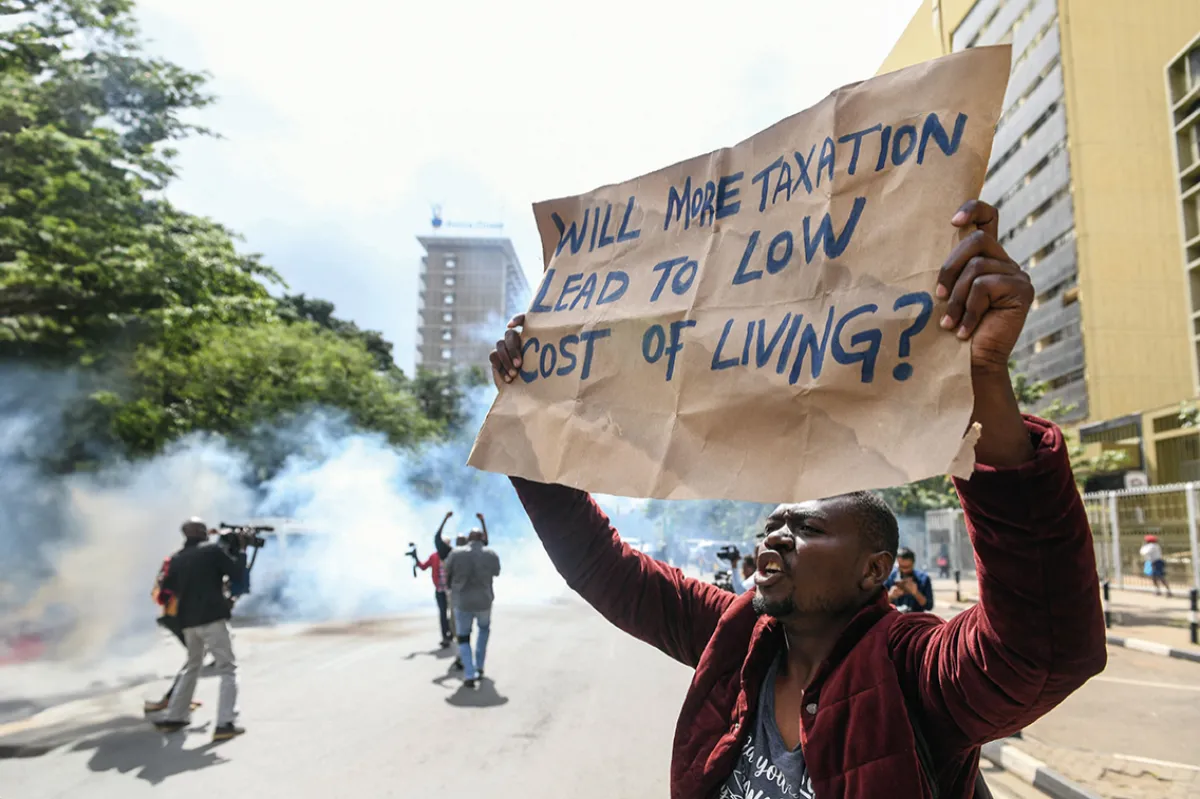
NAIROBI, Kenya — Small-scale traders in Nairobi’s Central Business District staged protests on Friday, August 28, over a revised Kenya Revenue Authority (KRA) customs benchmark that has raised the minimum yield for consolidated cargo from Sh2.5 million to Sh3.2 million.
The protests saw some businesses in parts of the CBD close as traders gathered and marched towards Times Tower, where KRA is headquartered. Traders have accused the tax authority of increasing the cost of importing goods and squeezing already narrow profit margins.
The new benchmark, which took effect on August 20, represents a Sh700,000 increase, or about 28 per cent, according to reports on the changes.
It particularly affects small-scale importers who consolidate shipments with other traders to share freight and clearance costs, including those importing merchandise from China.
Traders demand return to Sh2.5 million benchmark
The traders are demanding that KRA revert to the previous Sh2.5 million benchmark and engage them further before implementing measures they say could hurt small businesses.
They argue that the higher benchmark will increase the cost of importing merchandise, reduce profit margins and potentially force traders to raise prices for consumers.
“We want the government to listen to us. KRA should listen to us and allow us to continue with the benchmark of 2.5. They have already increased it to 3.2, which is not possible for businesses given the state of Kenya’s economy,” one trader said.
The demonstrations follow threats by traders in Kamukunji, Gikomba and Nyamakima to shut their businesses in protest against the new benchmark.
KRA says Sh3.2 million is not a flat tax
KRA has sought to clarify the basis of the new figure, saying the Sh3.2 million benchmark is not a fixed tax or a flat charge imposed on every container.
The authority says the figure is a minimum-yield benchmark used under a simplified customs clearance arrangement as part of its risk-management measures.
According to KRA, the actual tax payable depends on the nature, value and classification of goods contained in an individual shipment.
Importers whose goods are worth more than the benchmark are required to declare their actual value and pay the applicable taxes.
The clarification has done little to ease concerns among traders, who maintain that the higher benchmark will increase their costs and make it harder for small businesses to remain viable.
Why traders are opposed
Many small-scale traders use consolidated cargo to import goods, particularly from China, by sharing containers with other businesses.
Traders say the increase in the minimum benchmark will affect businesses that rely on this arrangement and could ultimately raise the cost of goods reaching Kenyan consumers.
The MSME Alliance of Kenya has also called for further consultations with KRA, saying the Sh3.2 million benchmark remains too high for many small and medium-sized traders.
The alliance acknowledged previous consultations with the revenue authority but urged further engagement over the impact of the revised benchmark.
Nairobi businesses divided over protests
The protests have not received uniform support across Nairobi’s trading community.
The Eastleigh Business Community urged traders in the area to keep their businesses open and avoid participating in street demonstrations, saying it was pursuing dialogue with KRA to address their grievances.
Business activity in Eastleigh consequently remained largely normal on Friday morning, even as parts of the CBD experienced closures and demonstrations.
Also Read: KRA grants temporary eTIMS relief ahead of June 30 tax deadline
In the CBD, however, several businesses remained closed as traders responded to calls for a shutdown over the customs changes.
The dispute comes amid broader concerns among Kenya’s small and medium-sized businesses over taxation, compliance costs and the rising cost of doing business.
For traders, the immediate demand remains clear: they want KRA to reconsider the Sh3.2 million benchmark and engage them on a system they say could have a significant impact on their livelihoods.
For KRA, the challenge is to maintain effective customs controls and protect revenue while ensuring that legitimate small-scale importers are not unfairly burdened.
The protests are expected to keep pressure on the authority to explain the new system and address concerns raised by traders.