


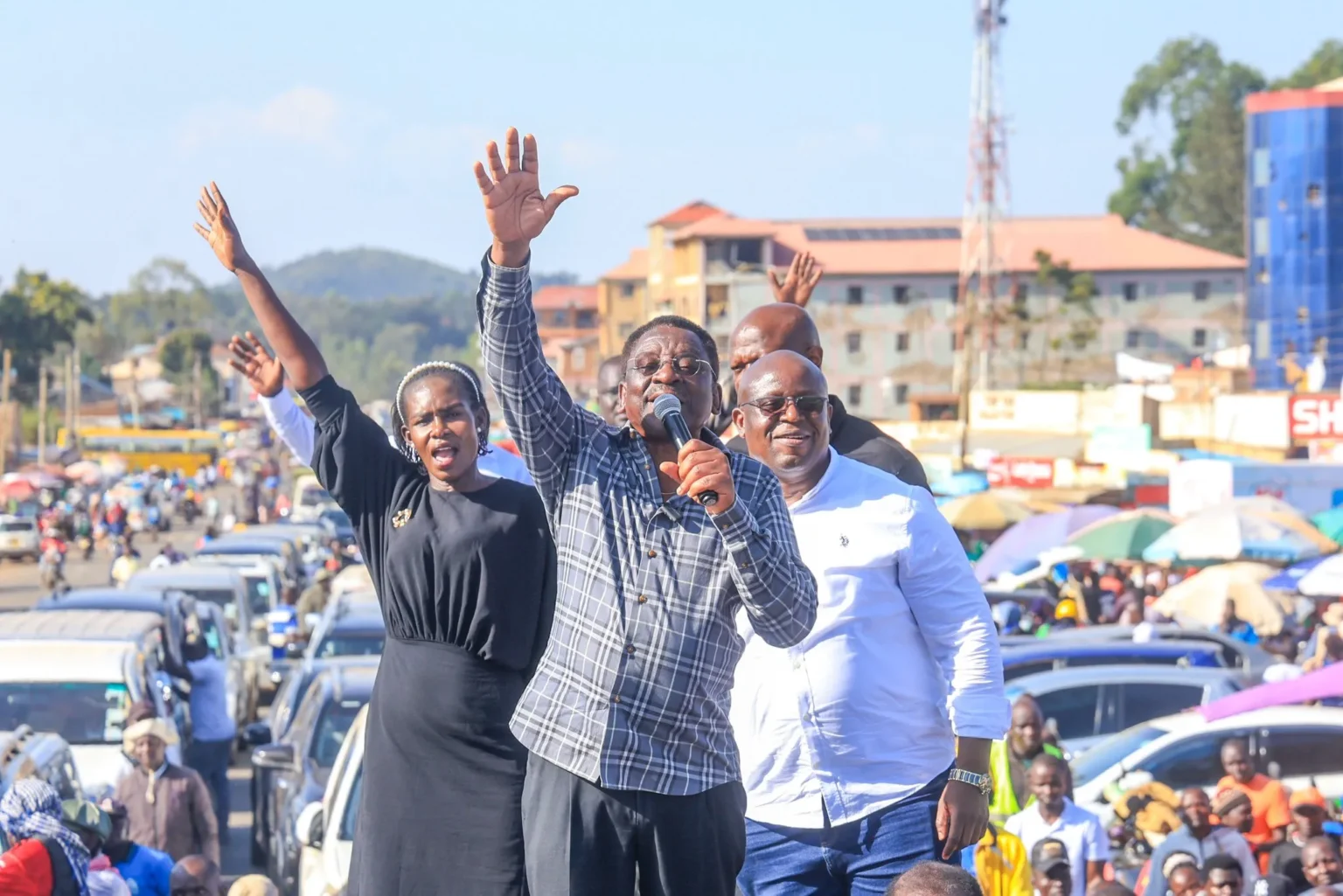
HOMA BAY, Kenya — Siaya Governor James Orengo has declared his intention to contest the presidency in the 2027 General Election, adding a new dimension to the increasingly crowded race to challenge President William Ruto.
Orengo made the declaration on Friday, August 28, 2026, during the burial of Steven Onyango, son of Linda Mwananchi advocate Newton Ogada, in Homa Bay County.
The veteran politician used the occasion to criticise President Ruto’s record and question his commitment to the Constitution before announcing that he was ready to seek the country’s highest office.
“Ruto, who didn’t believe in the Constitution, is now the president. Ruto was swearing with the Constitution he never supported. That is why we have these many problems,” Orengo said.
He then turned his attention to Homa Bay Senator Moses Kajwang’, who has recently attracted political attention over remarks interpreted as signalling support for President Ruto.
Orengo challenged Kajwang’ over the prospect of backing Ruto and declared that he was himself ready to contest the presidency.
“And you want to tell me there is no better Luo than Ruto that Kajwang can support. Kajwang, I am here. From today, know that I am the presidential candidate. A serious presidential candidate,” Orengo said.
The declaration places Orengo among the growing number of politicians positioning themselves for the 2027 presidential contest, as opposition parties and political movements seek to determine who will challenge Ruto.
Orengo’s announcement could also complicate discussions within the Linda Mwananchi movement over its preferred presidential candidate.
Nairobi Senator Edwin Sifuna has emerged as one of the movement’s most prominent figures, taking part in nationwide mobilisation efforts and increasingly being presented by some supporters as a potential presidential candidate.
The movement has also been exploring the possibility of establishing a formal political vehicle, with the question of its leadership and presidential ticket likely to become increasingly important as the 2027 election approaches.
Orengo’s declaration introduces another senior political figure with presidential ambitions into a movement that has publicly emphasised opposition unity.
However, there is no indication that Linda Mwananchi has formally endorsed Orengo as its presidential candidate, nor is there confirmation that the movement has split over the issue.
The immediate significance of Orengo’s announcement is therefore that he has personally moved from being discussed as a potential candidate to publicly declaring his intention to seek the presidency.
The declaration comes after political support for Orengo had begun emerging within parts of the Linda Mwananchi network.
Earlier in August, delegates from Homa Bay and Migori counties reportedly endorsed Orengo as a leader and preferred presidential candidate during mobilisation activities associated with the movement.
The developments have placed Orengo alongside a number of prominent opposition figures who are positioning themselves ahead of the 2027 election.
Among those associated with the broader opposition mobilisation are Sifuna, Trans Nzoia Governor George Natembeya, former Meru Governor Kawira Mwangaza and other political leaders.
The opposition has repeatedly spoken about the need to unite behind a single candidate to mount a credible challenge to Ruto.
The emergence of multiple presidential ambitions, however, could test that unity as parties and political formations begin negotiating alliances, endorsements and possible coalitions.
Orengo is no newcomer to Kenya’s highest-stakes political contests.
The Siaya governor is a veteran politician, constitutional lawyer and long-standing figure in Kenya’s pro-democracy movement.
He has served as Ugenya Member of Parliament, Minister for Lands, Siaya Senator and Senate Minority Leader before becoming governor of Siaya County in 2022.
He also previously contested the presidency.
In 2002, Orengo ran for president but failed to secure significant national support. He later became closely associated with Raila Odinga and the Orange Democratic Movement, where he emerged as one of the party’s senior lawyers and prominent political voices.
His political career has also been closely linked to Kenya’s constitutional reform movement.
During the era of one-party rule, Orengo was among politicians and lawyers who challenged the political establishment and advocated for multiparty democracy.
He subsequently became an influential participant in debates surrounding constitutional reform, devolution and the protection of democratic institutions.
Orengo’s decision to seek the presidency now places him in direct competition for political space with several other opposition figures while also positioning him as a potential challenger to Ruto.
For the opposition, the central question will be whether the various presidential ambitions can eventually be consolidated behind one candidate.
The 2027 contest is already taking shape around competing political alliances, with leaders seeking to expand their influence beyond traditional ethnic and regional political bases.
Orengo’s strong political roots in Nyanza give him an established base, but a successful presidential campaign would require him to build support nationally.
Also Read: James Orengo accuses Ruto of trying to turn ODM into ‘Luo party’
His constitutional credentials and decades-long political career could provide a distinctive platform, particularly among voters concerned about governance and the protection of democratic institutions.
But the governor faces the same challenge confronting other opposition hopefuls; Converting regional political influence into a broad national coalition capable of competing with the incumbent administration.
Orengo’s declaration comes as political activity intensifies across the country more than a year before the next General Election.
President Ruto is expected to seek a second term, while opposition leaders are increasingly testing their popularity and negotiating possible alliances.
The coming months are likely to bring greater clarity over which political movements will work together, which candidates will seek party nominations and whether the opposition can agree on a single presidential candidate.
For Orengo, Friday’s declaration marks the beginning of another presidential campaign.
Whether his ambition ultimately becomes the opposition’s preferred option—or remains one of several competing bids—will depend on the political negotiations and alliances that emerge before the 2027 election.