

KAMPALA, Uganda — General Muhoozi Kainerugaba’s declaration that he intends to seek Uganda’s presidency in 2031 has brought the country’s long-running succession debate into sharper focus, with questions emerging over the role of the military, the strength of civilian institutions and the direction of Uganda’s foreign policy.
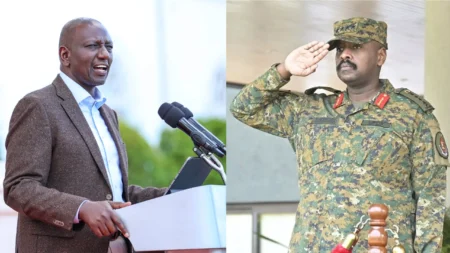
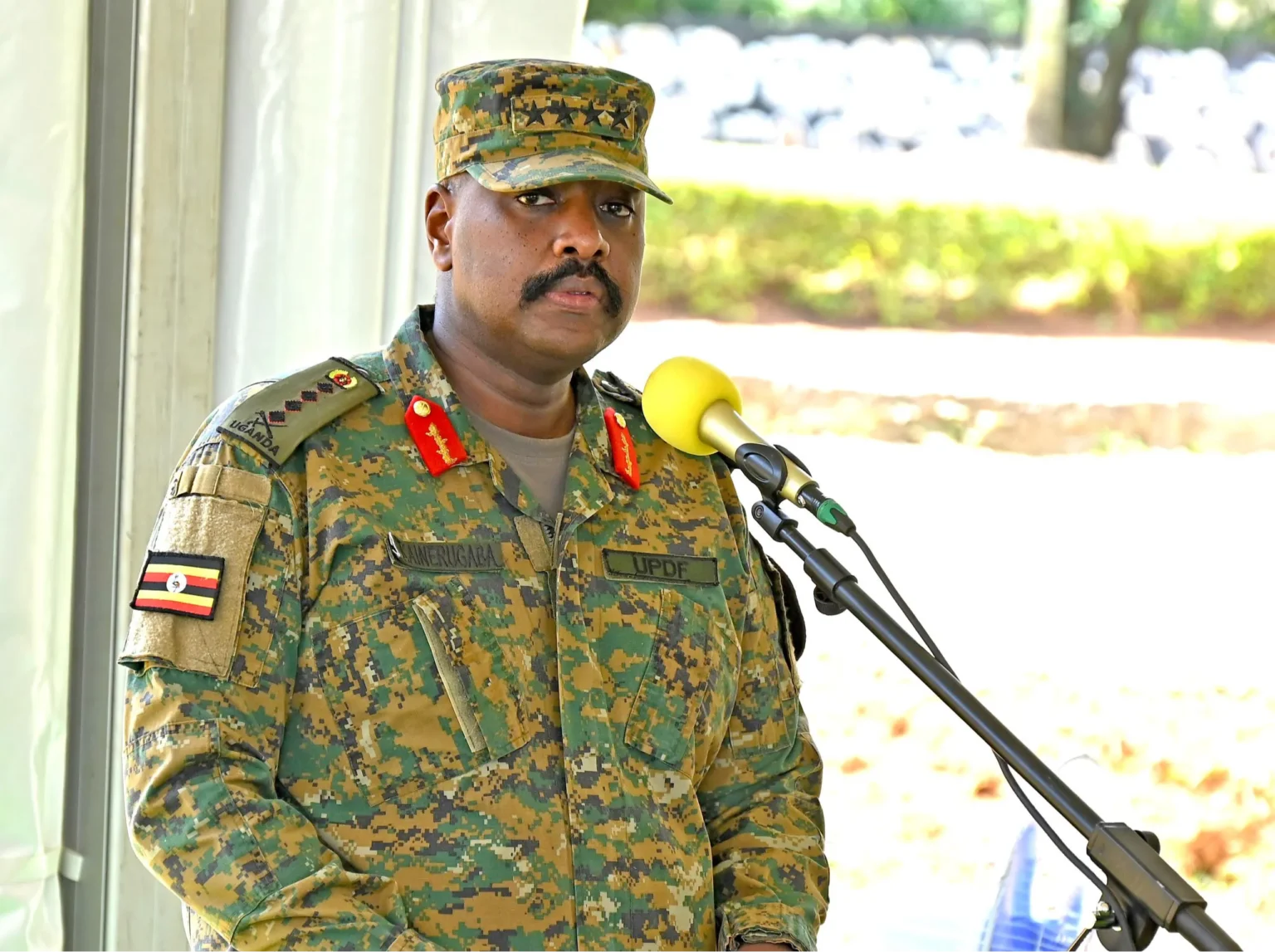
Kainerugaba, 52, Uganda’s Chief of Defence Forces (UPDF) and President Yoweri Museveni’s son, announced on Tuesday that he would seek “the highest office in the land” in 2031.
A day later, he went further, predicting that he would secure 90 per cent of the vote with the backing of his father, who has ruled Uganda since 1986.
“With my great father, Mzee’s, support I will get 90% in the elections in 2031,” Gen. Muhoozi wrote on X alongside a photograph of himself with Museveni.
The declaration is significant not simply because Museveni’s son wants to succeed him, but because Gen. Muhoozi is seeking the presidency while serving as the country’s top military commander and leading the Patriotic League of Uganda (PLU), a political mobilisation group.
That combination has intensified debate over whether Uganda’s eventual transfer of power will be driven primarily by civilian political institutions or by the influence of the military and the ruling establishment.
A succession shaped by the military
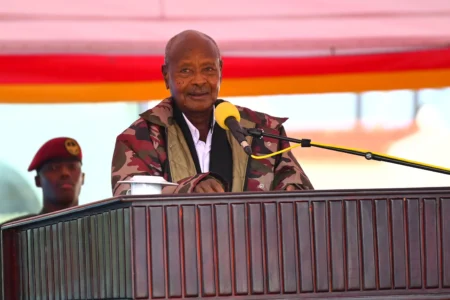
Museveni, 81, has governed Uganda since 1986 and has not formally designated a successor. Muhoozi, however, has increasingly emerged as the most prominent figure associated with the succession debate.
A 2026 study published in African Affairs by Edward Goldring of the University of Melbourne and Rebecca Tapscott of the University of Glasgow examined public attitudes towards Gen. Muhoozi and the question of succession. The researchers found that Muhoozi was widely viewed as a leading potential successor, but that his public approval was substantially lower than his father’s.
The distinction matters.
Museveni’s political support cannot automatically be assumed to transfer to his son simply because the two are closely aligned.
Gen. Muhoozi’s 90 per cent prediction also sets an exceptionally high benchmark for a politician who has yet to contest a presidential election.
His challenge will be to translate his father’s political machinery and influence into personal electoral legitimacy.
That task becomes more complicated because he would not be entering the race as an ordinary civilian politician.
He would be doing so after years at the centre of Uganda’s military establishment.
Where does the army end and politics begin?
Gen. Muhoozi’s dual position has long been a source of political controversy.
As CDF, he commands the Uganda People’s Defence Forces (UPDF) while simultaneously heading a political movement that has become increasingly visible in national politics.
His political activism has included mobilisation around Museveni’s government and increasingly direct interventions on political issues.
The 2031 contest could therefore test the boundaries between military authority and partisan politics.
For Uganda, the central question is whe ther the armed forces can maintain institutional neutrality while their commander openly seeks the presidency.
That question carries particular weight in a country where the military has historically played an important role in political power.
Gen. Muhoozi’s emergence as a presidential contender therefore puts the issue of civilian control of the military at the heart of the succession debate.
His foreign-policy statements have already caused friction
Gen. Muhoozi’s outspoken presence on social media has also created diplomatic challenges for Uganda.
In January, after Uganda’s disputed presidential election, he accused officials at the US Embassy in Kampala of helping opposition leader Bobi Wine evade security forces and announced that Uganda would suspend cooperation with the embassy, including security cooperation.
He later deleted the posts and apologised, saying he had been given incorrect information and had spoken with the US ambassador.
The episode nevertheless triggered a strong response in Washington.
US Senator Jim Risch, chairman of the Senate Foreign Relations Committee, said Muhoozi had “crossed a red line” and called for Washington to reconsider its security relationship with Uganda, including military cooperation and possible sanctions.
The incident highlighted a potential problem for Uganda’s future foreign policy: statements by a senior military commander can have consequences beyond domestic politics.
That becomes even more consequential if the same commander is positioning himself to become president.
Muhoozi and the Israel-Iran conflict
Gen. Muhoozi’s comments on international affairs have not been limited to Uganda-US relations.
In March, amid the Israel-Iran conflict, he publicly said Uganda would be prepared to support Israel militarily if Israel needed assistance.
“We stand with Israel because we are Christians,” he wrote, adding that Uganda would enter the conflict on Israel’s side if Israel faced an attempt to destroy or defeat it.
The remarks were made by Uganda’s serving military chief rather than a private political commentator.
That distinction matters.
Foreign policy is ultimately determined by the government, but public statements by a country’s top military commander can create uncertainty over whether his views represent official policy, military thinking or his personal position.
Should Gen. Muhoozi eventually become President, those statements offer an indication of the foreign-policy questions that could confront his administration.
The media question
Gen. Muhoozi’s record on the media has also become part of the debate over what his possible presidency could mean for Uganda’s democratic institutions.
In June, he ordered the shutdown of several Nation Media Group operations in Uganda, including Daily Monitor, NTV Uganda and Spark TV. Armed security personnel were deployed around media facilities in Kampala.
Gen. Muhoozi publicly declared that he did not believe in a free press and said the targeted outlets would not reopen without his permission.
The outlets eventually resumed operations in July after roughly a month-long shutdown.
The episode raised concerns over the space available for independent journalism in Uganda and demonstrated the extent to which Gen. Muhoozi’s military authority could intersect with civilian institutions.
For a future presidential candidate, his record on media freedom is likely to remain an important part of the national debate.
The bigger question for Uganda
Gen. Muhoozi could ultimately seek the presidency through an electoral process and win.
His supporters can argue that his military experience, political organisation and close relationship with Museveni give him the experience and network necessary to govern.
But his candidacy presents Uganda with questions that go beyond an individual election.
First is the institutional question: Can the military remain politically neutral when its serving commander is a presidential candidate?
Second is the democratic question: Can a transition from a father who has ruled for four decades to his son be perceived as a genuinely competitive political succession?
Also Read: Muhoozi declares PACEID illegal, threatens arrests and sanctions against media houses
Third is the foreign-policy question: Would Gen. Muhoozi’s outspoken approach to international affairs make Uganda’s relationships with major partners more predictable or more difficult to manage?
And there is a fourth question: How much of Museveni’s political support actually belongs to Muhoozi?
Research published in African Affairs suggests the answer cannot simply be assumed. Muhoozi may be the most prominent potential successor, but his public standing has historically lagged behind that of his father.
His declaration of a 90 per cent victory therefore says as much about his confidence as it does about the political challenge ahead.
A test bigger than 2031
The 2031 election is still five years away, but Gen. Muhoozi’s declaration has already moved Uganda’s succession debate into a new phase.
The central issue will not only be whether Museveni’s son can win an election.
It will be whether Uganda can demonstrate that political power can change hands through institutions strong enough to stand above family connections, military influence and the power of the incumbent establishment.
If Gen. Muhoozi contests in 2031, the election could become a defining test of whether Uganda is entering a genuine political transition — or preparing for the continuation of the Museveni system under a new generation and a president who currently commands the country’s armed forces.