


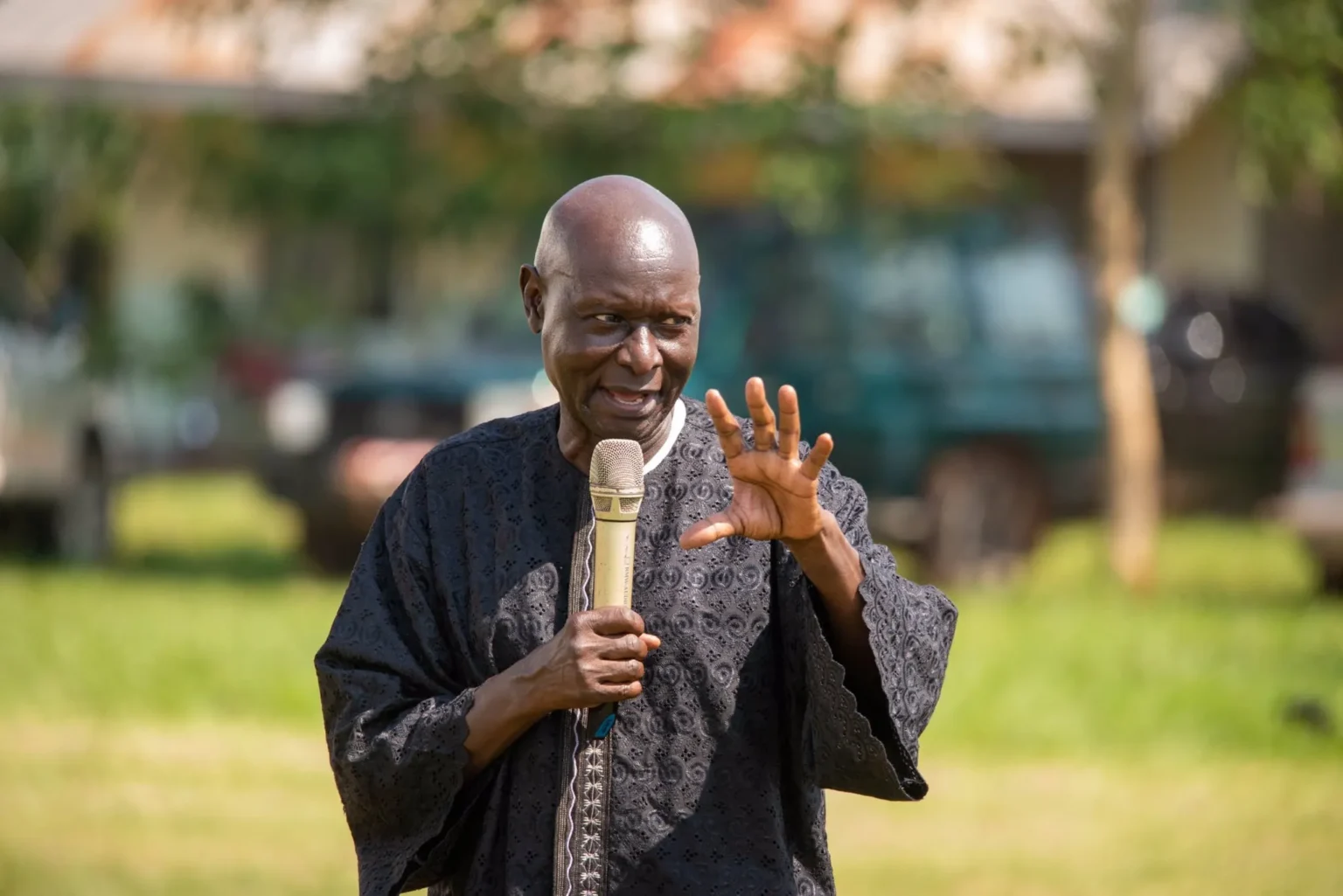
KAMPALA, Uganda — For much of the past two decades, Olara Otunnu’s name has been associated with Uganda’s opposition politics.
He challenged President Yoweri Museveni’s government on governance, democracy and human rights. He contested the presidency. He criticised the ruling National Resistance Movement (NRM) and repeatedly called for political reforms.
Today, that same government is asking the world to entrust him with one of the most influential diplomatic positions on the planet.
In one of the most unexpected turns in Uganda’s recent political history, Kampala has formally nominated former United Nations Under-Secretary-General Olara Otunnu to become the next Secretary-General of the United Nations.
Official correspondence seen by Vivid Voice News confirms that Uganda’s nomination has now been circulated to all 193 UN member states, formally placing Otunnu among the candidates seeking to succeed António Guterres when his second and final term expires at the end of 2026.
The nomination instantly transforms what many expected to be a routine international selection process into a story that reaches far beyond diplomacy.
It raises a deeper question.
How did one of President Museveni’s longest-serving political rivals become Uganda’s choice to represent the country in the race for the world’s highest diplomatic office?
The answer says as much about Uganda’s foreign policy ambitions as it does about the difference between domestic politics and international diplomacy.
A nomination that few expected
The nomination became public through a joint communication dated July 25, 2026, signed by United Nations General Assembly President Annalena Baerbock and Security Council President Zenon Ngay Mukongo.
The letter informed member states that Uganda had officially submitted Otunnu’s candidature.
“The Republic of Uganda has presented the nomination of Mr. Olara Otunnu as candidate for the position of Secretary-General.”
The two UN leaders further stated:
“We have the further honour to forward the communication and documents received from the Permanent Mission of the Republic of Uganda to the United Nations dated 24 July 2026 in this respect.”
While the documents quietly entered the UN system, the announcement remained absent from public discourse in Kampala.
When contacted, Uganda’s Permanent Representative to the United Nations, Ambassador Adonia Ayebare, confirmed the nomination.
“The official government announcement will be made on Monday. Let’s wait for that time for details,” Ayebare said.
His confirmation ended speculation and officially placed Uganda in one of the world’s most consequential diplomatic contests.
Politics stops where diplomacy begins
Perhaps the most remarkable aspect of Otunnu’s nomination is not his qualifications.
Those have rarely been questioned.
Rather, it is the political symbolism.
For years, Otunnu represented one of Museveni’s most articulate critics.
After returning from international service, he became president of the Uganda People’s Congress and later contested the 2011 presidential election, positioning himself directly against Museveni.
Throughout that period, he consistently criticised the government’s democratic record and governance practices.
His speeches often portrayed Uganda as a country drifting away from constitutionalism and accountable government.
Few would have imagined that the same administration would one day endorse him for the world’s most prestigious diplomatic position.
Yet international diplomacy often follows different calculations from domestic politics.
Unlike Cabinet appointments or electoral contests, nominations to international offices are frequently driven less by political loyalty than by global credibility.
Otunnu possesses something relatively few Ugandans can claim.
He is already deeply embedded within the institutional history of the United Nations.
A career built inside the United Nations
Long before entering opposition politics, Otunnu had established himself as one of Africa’s most respected diplomats.
He served as Uganda’s Permanent Representative to the United Nations between 1980 and 1985, a period during which he also presided over the Security Council.
He later became President of the International Peace Academy, now known as the International Peace Institute, before returning to the UN in one of its most influential humanitarian roles.
From 1998 until 2005, Otunnu served as the organisation’s first Under-Secretary-General and Special Representative for Children and Armed Conflict.
The position placed him at the centre of some of the world’s most devastating conflicts, from Sierra Leone and Liberia to Sudan, Afghanistan and the Democratic Republic of Congo.
His office successfully pushed the Security Council to recognise the recruitment of child soldiers as an international security issue rather than merely a humanitarian concern.
Uganda’s nomination documents describe those achievements as evidence of his ability to lead an increasingly fragmented international system.
According to the government, Otunnu combines “over four decades of leadership within the United Nations system and the wider international community.”
The nomination further highlights his role in establishing the monitoring mechanism created under Security Council Resolution 1612, which continues to document grave violations against children in conflict zones.
For Kampala, those accomplishments outweigh domestic political disagreements.
Uganda’s larger diplomatic ambition
Otunnu’s nomination also reflects Uganda’s broader foreign policy calculations.
Should he ultimately secure the position, Uganda would become the first East African country to produce a United Nations Secretary-General.
That achievement would dramatically elevate Uganda’s diplomatic profile.
Although the Secretary-General serves all member states rather than the interests of his or her home country, the office carries enormous symbolic significance.
Countries whose nationals occupy major international positions often gain greater diplomatic visibility, stronger influence within multilateral institutions and enhanced credibility in international negotiations.
Uganda has increasingly sought to position itself as a regional security actor through peacekeeping operations in Somalia and mediation efforts involving South Sudan and eastern Democratic Republic of Congo.
Supporting a candidate with Otunnu’s international standing reinforces that image.
It projects Uganda not merely as a regional military contributor but also as a country capable of producing global diplomatic leadership.
Can Otunnu actually win?
Strong credentials alone, however, rarely determine who becomes Secretary-General.
The selection process remains one of the most politically sensitive appointments in international affairs.
Under the UN Charter, the Security Council must first recommend a single candidate before the General Assembly conducts the formal appointment.
Any one of the Council’s five permanent members—the United States, China, Russia, the United Kingdom or France—can effectively block a candidate through its veto power.
That means successful candidates require not only international respect but also geopolitical acceptability.
Informal regional balance further complicates the process.
Although no written rule governs rotation, many diplomats argue that Africa has a strong claim after nearly two decades without leading the organisation.
Only two Africans have previously served as Secretary-General: Egypt’s Boutros Boutros-Ghali and Ghana’s Kofi Annan.
Since Annan completed his tenure in 2006, the continent has not occupied the office.
That argument may strengthen Otunnu’s candidacy.
Equally important will be whether African governments unite behind a single candidate rather than dividing support among multiple contenders.
A vision for a divided world
Accompanying his nomination is a vision statement that portrays the United Nations as standing at what Otunnu calls “a historic moment.”
He identifies multiple overlapping crises confronting the international community, including armed conflict, climate change and the rapid development of artificial intelligence.
Among his proposals is the creation of a specialised UN institution responsible for developing international governance frameworks for artificial intelligence.
He also identifies Ukraine, Gaza, Sudan, Iran and the Democratic Republic of Congo (DRC) as conflicts requiring renewed diplomatic engagement.
His central argument is that the organisation requires proactive rather than reactive leadership.
According to his vision statement, the next Secretary-General should serve as “a bridge builder” capable of generating creative solutions during periods of geopolitical confrontation.
Whether those ideas resonate inside the Security Council remains uncertain.
The political paradox
Back home, however, Otunnu’s nomination may prove almost as significant as the international contest itself.
In a political environment often characterised by sharp partisan divisions, the decision to nominate a former opposition presidential candidate demonstrates an unusual separation between political rivalry and national representation.
It suggests that international credibility can, at least occasionally, transcend domestic disagreements.
Also Read: Ugandan opposition slams Museveni for defending Muhoozi’s clamp down on critics
The government has offered no public explanation for its decision.
Neither has Otunnu commented extensively on the political symbolism.
Yet the nomination itself speaks loudly.
After years of standing on opposite sides of Uganda’s political divide, Museveni’s government and one of its most persistent critics now find themselves pursuing the same objective.
Not because their politics have necessarily converged.
But because, on the global stage, Uganda appears to believe that Olara Otunnu represents its strongest diplomatic case.
Whether that calculation ultimately persuades the world’s major powers is a question that will be answered in New York rather than Kampala.
But the nomination has already accomplished something unusual.
It has transformed one of Uganda’s longest-running political rivalries into an unexpected moment of national diplomacy.
For a country whose domestic politics often appear deeply polarised, that may be almost as remarkable as the nomination itself.