

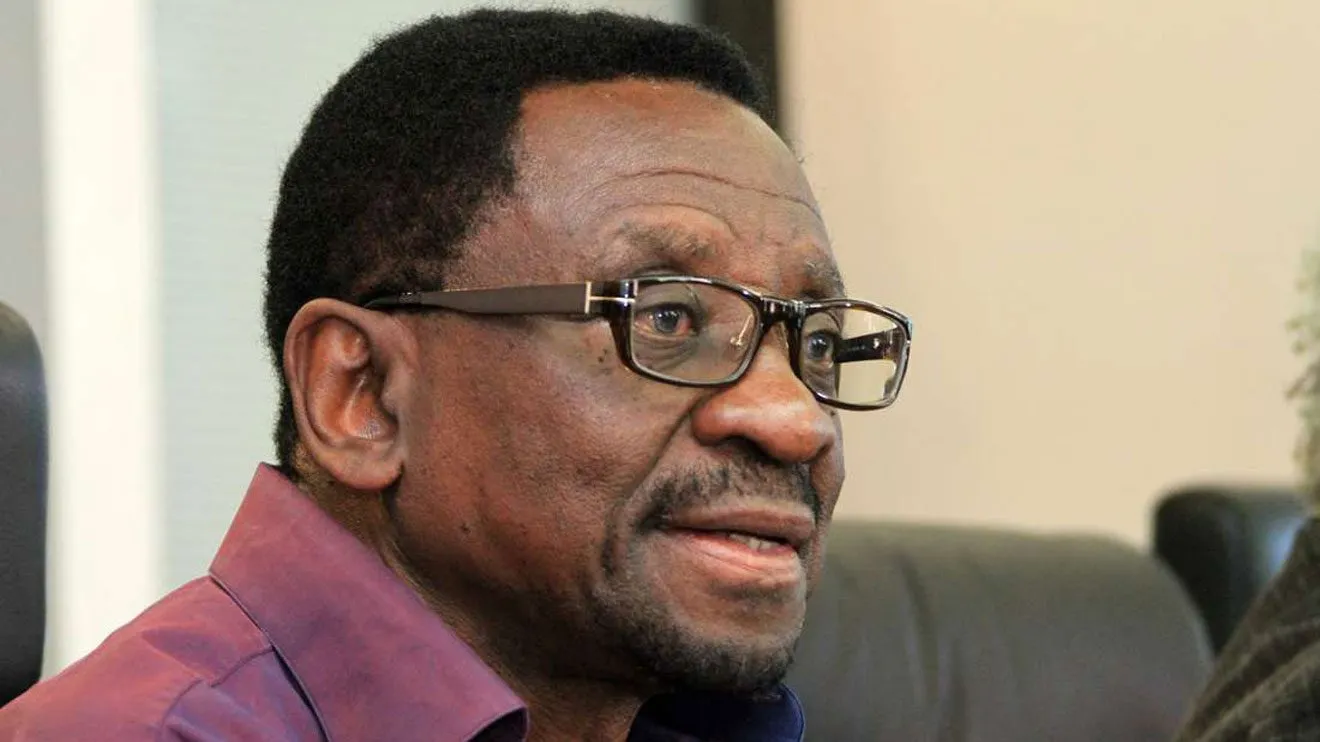
HOMA BAY, Kenya — Before Siaya Governor James Orengo addressed supporters in Homa Bay on Wednesday 22, July 2026, stones were already flying.
Youths had blocked sections of the Homa Bay–Rongo Road with rocks and construction materials. Rival groups confronted one another as the Siaya Governor’s convoy approached the town. For a brief moment, the scenes resembled a local political dispute.
In reality, they reflected something much larger: a growing struggle over who will define the future of the Orange Democratic Movement (ODM) in the post-Raila Odinga era.
When calm eventually returned and Orengo stepped before cheering crowds, he delivered a message that was less about a single political disagreement and more about what he believes is happening to one of Kenya’s most influential political movements.
His target was not only President William Ruto.
It was also ODM itself.
In one of his sharpest public attacks since the party entered a cooperation arrangement with the Kenya Kwanza administration, Orengo accused Ruto of deliberately weakening ODM, abandoning commitments made under the cooperation agreement and reducing a once-national political movement into what he described as a regional Luo party.
“I tell Ruto to stop betraying Raila in his grave. He is working hard to reduce ODM to a Luo political party but that is unacceptable,” Orengo said.
The remarks immediately intensified an increasingly visible debate within ODM: what becomes of a party built around the political influence, symbolism and national reach of Raila Odinga when the country’s political focus begins shifting toward a new generation of leadership?
A party at a crossroads
For nearly three decades, ODM’s political identity was inseparable from Raila Odinga’s national ambitions.
The party became more than an electoral vehicle. It evolved into a movement associated with constitutional reform, devolution, democratic activism and opposition politics. Supporters across Kenya viewed it as a national platform rather than a regional organisation.
That identity is now being tested.
The cooperation agreement between ODM and President Ruto’s administration created opportunities for engagement but also generated deep unease among sections of the party’s traditional support base.
Some leaders argue that cooperation offers influence and policy gains. Others fear it risks diluting the party’s opposition credentials and ideological foundations.
Orengo belongs firmly to the latter camp.
According to the governor, one of the central reasons ODM agreed to cooperate with the government was to pursue reforms that would ease economic pressures facing ordinary Kenyans.
Instead, he argues, those commitments have not been honoured.
“Ruto is working against the will of our late leader Raila. He has refused to honour the ten point agenda and that is why Kenyans continue to be overwhelmed by the high cost of living,” Orengo said.
The criticism touches on one of the most sensitive political issues in Kenya today.
While political alliances can reshape power structures, voters ultimately judge governments through everyday realities such as food prices, fuel costs, employment opportunities and household incomes.
Orengo’s argument suggests that cooperation without tangible economic results risks alienating supporters who expected change.
The succession question no one can avoid
Beneath the public criticism lies another question that many ODM leaders have been reluctant to discuss openly.
Who inherits the political space Raila leaves behind?
Political parties built around dominant personalities often face difficult transitions once their founding leaders step back from frontline politics. History offers numerous examples across Africa and beyond where movements struggled to maintain coherence after losing the figures who unified them.
ODM now faces a similar challenge.
Orengo’s criticism of senior party leaders suggests he sees a risk that ODM could abandon its national ambitions and become increasingly confined to its traditional strongholds.
He reserved some of his strongest language for the current party leadership.
“The people on whom we bestowed the leadership of ODM have become sellouts. One is going to vie a seat in Siaya and another one going to vie a seat in Homa Bay instead of seeking presidency,” Orengo said.
Though he did not merely frame the issue as an internal leadership dispute, his comments pointed toward a broader concern about political ambition and national relevance.
To Orengo, ODM’s future depends on whether it continues positioning itself as a movement capable of competing for national power or retreats into regional politics.
Luo Nyanza and the politics of influence
The debate also reflects wider anxieties within sections of Luo Nyanza about political representation after decades in which Raila Odinga served as both regional figurehead and national opposition leader.
Many communities measure political influence not simply through elected positions but through their ability to shape national conversations, negotiate policy priorities and secure development resources.
Orengo made that argument explicitly.
“I want to lead our community in the presidential race. Our community must have space on the national table for negotiation on resources and power distribution,” he said.
The statement was notable not only because it signalled personal political ambition but because it framed the conversation around representation and bargaining power.
In Kenya’s coalition-driven politics, communities often seek leaders capable of negotiating influence within national power structures. Orengo appears to be positioning himself as one of the figures willing to take on that role.
A struggle playing out on the ground
The confrontation in Homa Bay demonstrated that these debates are no longer confined to party meetings and political speeches.
The attempt by youths to block Orengo’s convoy illustrated how factional tensions are increasingly manifesting in public spaces.
Orengo accused unnamed leaders of using young people to intimidate him whenever he visits the region.
Also Read: Orengo: DCP’s Ol Kalou win signals Ruto is headed for one-term presidency
“I am one of the leaders who fought for devolution when they were nowhere. Nobody can prevent me from holding rallies in Homa Bay County. I will come back and do it in each Sub-county,” he said.
The governor’s determination to continue touring the region suggests he views the current political contest as a long-term battle rather than a temporary disagreement.
His announcement that he would return for a major Linda Mwananchi rally indicates that the emerging divisions within ODM are likely to deepen rather than fade in the months ahead.
The bigger political significance
The events in Homa Bay may appear local.
Their implications are national.
The dispute touches on questions that will shape Kenya’s political landscape heading into 2027:
Can ODM maintain its identity as a national movement?
Will cooperation with government strengthen or weaken the party?
Who will emerge as the most influential voice within Luo Nyanza after Raila?
And perhaps most importantly, can a party founded around one of Kenya’s most consequential political figures successfully redefine itself for a new era?
For now, no definitive answers exist.
What is becoming increasingly clear, however, is that the contest over ODM’s future has already begun.
The stones thrown on a roadside in Homa Bay were not merely signs of local unrest.
They were early signals of a larger struggle unfolding inside one of Kenya’s most significant political institutions.
And as the country moves closer to another election cycle, that struggle may prove just as consequential as the contest for State House itself.