




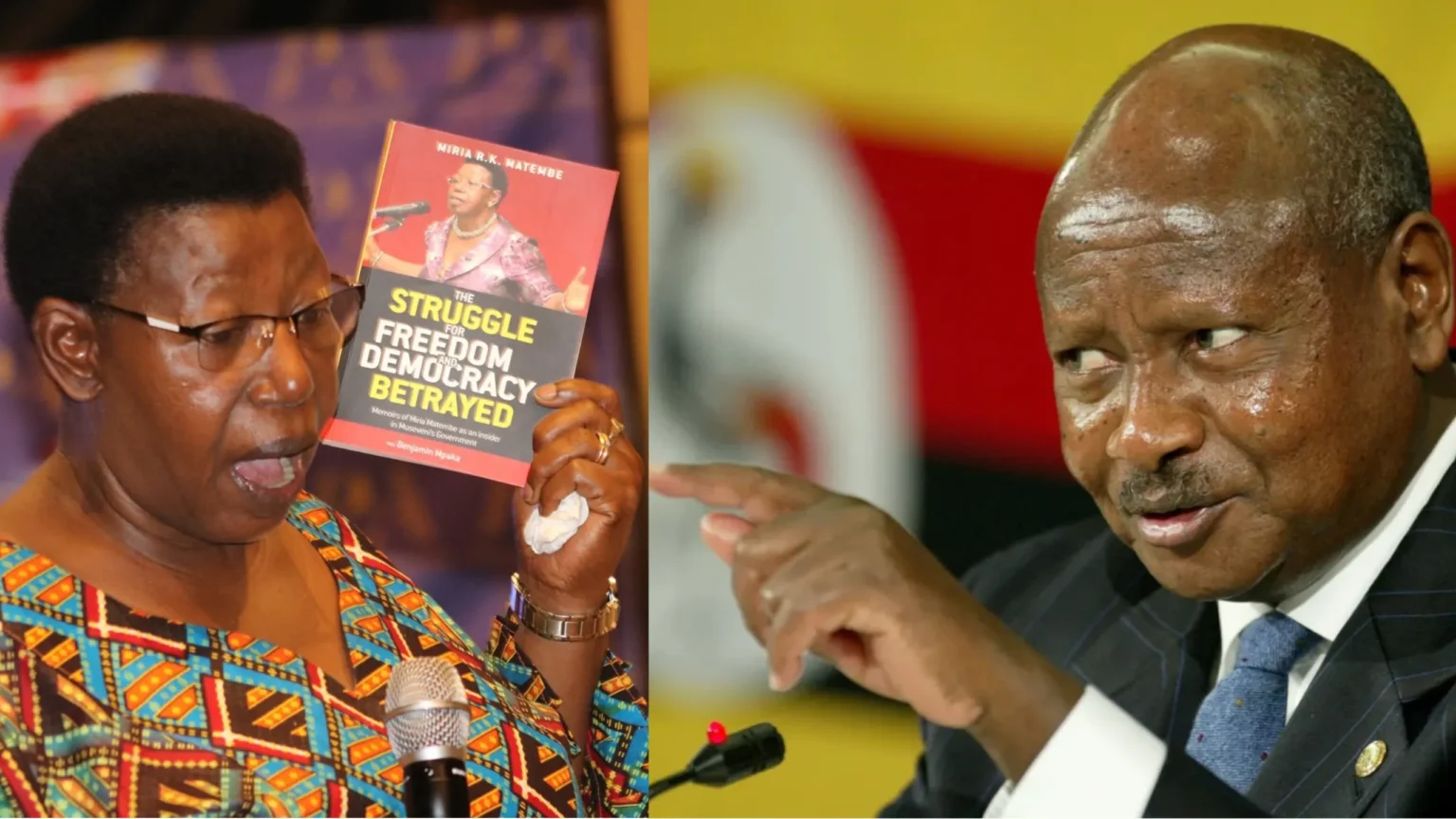
KAMPALA, Uganda — The remand of former Ethics and Integrity Minister Dr Miria Matembe to Luzira Prison has reignited debate over a remarkable promise she said President Yoweri Museveni personally made to her years ago: that she would never be arrested or imprisoned under his rule.
The pledge, detailed in Matembe’s 2019 memoir The Struggle for Freedom and Democracy Betrayed, has resurfaced after the veteran politician and former Museveni ally was charged with promoting sectarianism and remanded to prison pending a bail hearing.
For many Ugandans, the development has revived questions about the dramatic deterioration of a political relationship that once placed Matembe among the most prominent figures in the ruling National Resistance Movement (NRM).
A promise remembered
In her memoir, Matembe recounts a private meeting with Museveni following her public break with the government after opposing the removal of presidential term limits.
According to her account, she confronted the President about what she viewed as his departure from the ideals that had inspired Uganda’s 1986 liberation struggle.
The discussion eventually turned to Museveni’s wartime past and Matembe’s fears that her criticism of the government could make her a target.
She wrote that she told the President she feared becoming an enemy because of their political disagreements.
Museveni reportedly responded by assuring her that she had nothing to fear.
According to Matembe’s account, the President told her:
“Matembe, I give you my word. Under my watch, you will never be arrested or killed.”
The statement, which was published seven years before her latest court appearance, has gained renewed attention following her remand to Luzira Prison.
From Cabinet minister to government critic
Matembe was once among the most influential women in Museveni’s government.
A lawyer, politician and women’s rights advocate, she served as Minister of Ethics and Integrity and was widely regarded as a prominent figure within the NRM during the movement’s formative years.
However, her relationship with the ruling establishment gradually deteriorated as she became increasingly critical of constitutional changes, governance practices and what she described as growing authoritarianism within government.
In her memoir, Matembe argued that Museveni had abandoned the democratic ideals that initially attracted her to the National Resistance Movement (NRM).
She accused the government of embracing corruption, patronage and constitutional manipulation to prolong political power.
The book chronicles her transformation from insider to outspoken critic and details a series of confrontations with the President over governance and democracy.
The charge against Matembe
The renewed focus on Museveni’s reported promise comes after Matembe’s court appearance on June 30.
Prosecutors allege that she made statements during an interview on DK TV Uganda suggesting that public funds were disproportionately benefiting Banyankole women ministers.
Authorities argue the remarks were likely to promote hostility and ill-will against members of a particular community, contrary to Uganda’s laws against sectarianism.
She was charged under Section 38(1)(d) of the Penal Code Act.
Matembe denied the accusation.
Her legal team immediately sought bail, citing her age and health condition.
However, Grade One Magistrate Sheilla Gloria Atim deferred consideration of the application, saying the court had not received sufficient medical evidence and that time constraints prevented a full hearing.
The matter was adjourned to July 1 for a formal bail application, and Matembe was remanded to Luzira Prison.
A week of uncertainty
The court appearance followed days of uncertainty regarding Matembe’s whereabouts.
Human rights organisations, lawyers and civil society groups had raised concerns after reports emerged that she could not be located following a security operation at her home.
Family members later said she had evaded an earlier arrest attempt after receiving a warning while exercising near her residence.
According to relatives, she spent several days in hiding before being arrested from another location and transferred to military facilities before eventually appearing in court.
The incident prompted calls from the Uganda Law Society and civil rights groups demanding that authorities disclose her whereabouts and respect due process requirements.
A relationship defined by disagreement
Perhaps the most striking sections of Matembe’s memoir are not the passages describing Museveni’s reported promise but her reflections on how their relationship collapsed.
She recounts directly comparing Museveni’s constitutional legacy to those of former Ugandan leaders Milton Obote and Idi Amin.
In one account, she told the President that all three leaders had undermined constitutional governance through different methods.
Also Read: The betrayal of a comrade: Why Museveni must end the ‘endless injustice’ against Besigye
She argued that while Obote and Amin dismantled constitutional structures through direct political action, Museveni had weakened them through constitutional amendments and political patronage.
Matembe also described telling Museveni that he had become a fundamentally different leader from the one she had originally followed.
Using an analogy involving the palm and back of her hand, she said the President no longer reflected the ideals he once championed.
The exchange became one of the most widely discussed passages in her memoir and remains central to understanding her political evolution.
Symbolism beyond the courtroom
Matembe’s prosecution comes at a time of heightened debate over freedom of expression, political dissent and state authority in Uganda.
Supporters view her as a veteran democracy advocate being targeted for expressing controversial political opinions.
Government officials, however, maintain that the case concerns alleged violations of Uganda’s laws against sectarianism and should be treated as a legal matter rather than a political dispute.
Regardless of the outcome, her remand has drawn attention not only because of the charges she faces but because it appears to contradict a personal assurance she publicly attributed to President Museveni.
Whether the reported promise was symbolic, political or personal, it now stands in sharp contrast to the image of the 73-year-old former minister being escorted into Luzira Prison.
For many observers, that contrast has become one of the most striking political stories surrounding Matembe’s latest legal battle.