

NAIROBI, Kenya — President William Ruto’s recent public attacks on The Standard Media Group and KANU chairman Gideon Moi have triggered a fresh debate about media freedom, political accountability, and the relationship between the State and independent journalism in Kenya.
What began as criticism of newspaper headlines has rapidly escalated into one of the most direct confrontations between a sitting Kenyan President and a major media house in recent years, raising questions about whether the dispute reflects growing tensions between the government and sections of the press ahead of the 2027 General Election.
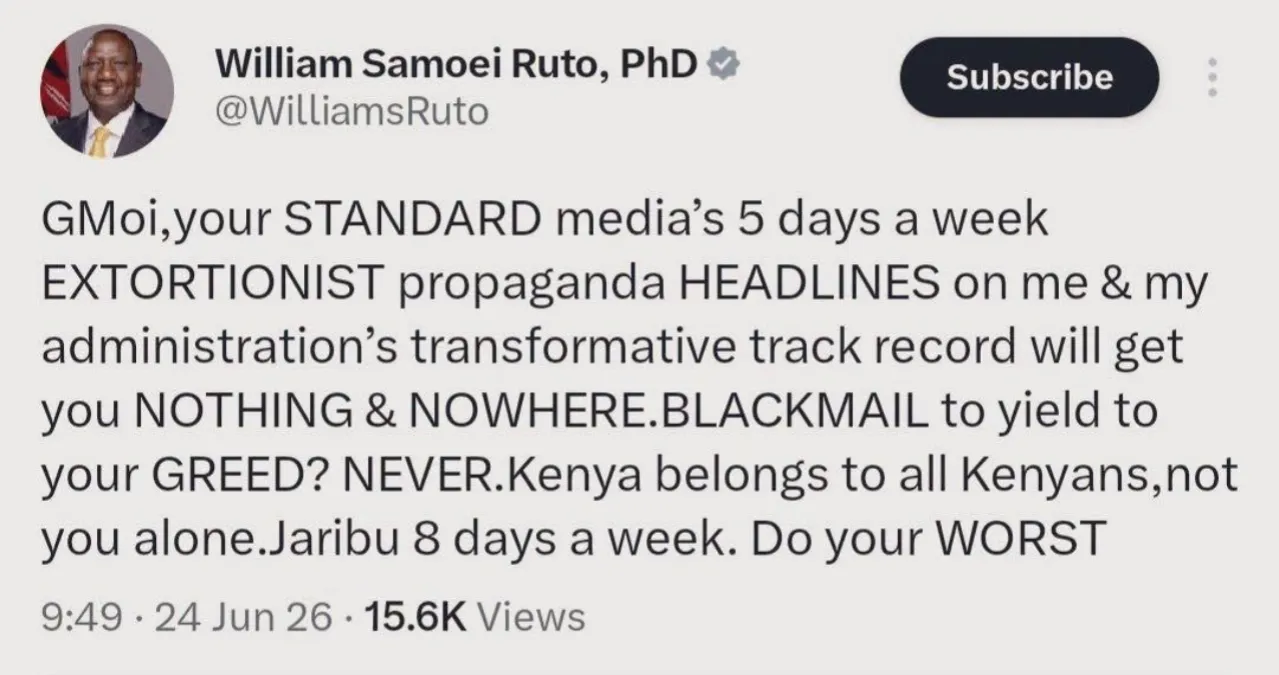
The confrontation intensified after President Ruto accused The Standard Media Group of running what he described as an “extortionist propaganda” campaign against his administration.
In a series of strongly-worded posts on X, the President alleged that the Gideon Moi-linked media house had embarked on a sustained effort to discredit his government and its development record.
“GMoi, your STANDARD media’s 5 days a week EXTORTIONIST propaganda HEADLINES on me & my administration’s transformative track record will get you NOTHING & NOWHERE.BLACKMAIL to yield to your GREED? NEVER.Kenya belongs to all Kenyans,not you alone.Jaribu 8 days a week. Do your WORST,” the President wrote.
Ruto later escalated the dispute by accusing Gideon Moi of failing to pay employees while continuing to publish critical headlines targeting his administration.
“Bro, the BILLIONAIRE you are;HIDING behind ‘debts’;forcing many months’ UNPAID labour slaving to defend your STANDARD headlines ‘BOLD’ extortion GANGSTERISM driven by GREED;is HEARTLESS to loyal workers, INSULT to journalism and BETRAYAL to free media that STANDARD once belonged,” President Ruto added.
The President portrayed the newspaper’s coverage as politically motivated and driven by private interests rather than public accountability.
The remarks were unusually personal, targeting not only the media house but also its perceived ownership, a move that immediately attracted national attention.
Why is Ruto attacking The Standard Media Group?
The dispute cannot be understood solely through the lens of journalism.
Several political and economic factors appear to be shaping the confrontation.
First, The Standard has consistently published front-page stories highlighting concerns over taxation, governance, public debt, unfulfilled campaign promises, police conduct, and growing public dissatisfaction with the Kenya Kwanza administration.
Many of these issues have become politically sensitive following the Gen Z-led protests of 2024 and the continuing public scrutiny of the government’s economic policies.
Second, the confrontation carries a political dimension.
Gideon Moi remains one of the country’s most prominent opposition figures and continues to lead KANU. While his direct influence on day-to-day editorial decisions has never been publicly demonstrated, the association between the Moi family and Standard Group has often made the media house a political target.
By framing the dispute as a battle against Gideon Moi rather than simply a disagreement with journalists, the President appears to be turning a media criticism issue into a political contest.
Third, there are significant commercial interests at play.
Standard Group has publicly stated that the government owes the company substantial amounts in unpaid advertising and service-related debts. The media house has argued that delayed government payments have affected its operations and employees.
The issue of government advertising has historically been a sensitive pressure point in Kenya’s media industry because many news organisations depend on public-sector advertising revenue to support operations.
The Standard Media Group’s response
Rather than backing down, The Standard Media Group issued one of its strongest public defences in recent years.
The company rejected allegations that its journalism is motivated by blackmail, extortion, or political interests. It insisted that its reporting is guided by facts, professional ethics, and the public interest.
In a statement signed by Group Chief Executive Officer Chaacha Mwita, the company argued that criticism of media reporting should be addressed through established legal and regulatory mechanisms rather than through public attacks from the country’s highest office.
The newspaper subsequently published a defiant front-page response declaring that it would not bow to intimidation or blackmail.
The Standard also highlighted the issue of unpaid government obligations, arguing that public criticism of the company should be accompanied by action to settle debts owed to the media house.
Media freedom at the centre of the debate
The dispute has revived broader concerns about the state of media freedom in Kenya.
Article 34 of the Constitution guarantees freedom and independence of the media and explicitly prohibits State control over editorial content.
Kenya has historically enjoyed one of Africa’s most vibrant media environments, with newspapers, television stations, radio broadcasters, and digital platforms often playing an aggressive watchdog role.
However, media organisations have repeatedly raised concerns over indirect pressure, including:
- Withdrawal or withholding of government advertising.
- Threats of legal action.
- Online harassment of journalists.
- Political attacks on editorial independence.
- Attempts to delegitimise critical reporting.
Media rights advocates argue that when senior government officials publicly label journalists or media houses as enemies, propagandists, or extortionists, it can create a hostile environment for independent reporting.
Reactions from media and civil society
The Kenya Union of Journalists (KUJ), legal scholars, opposition leaders, and civil society organisations have criticised the President’s remarks.
Many argue that public officials have a right to challenge inaccurate reporting but should do so through legal channels, including the Media Complaints Commission and the courts.
Critics contend that the President’s comments risk undermining public confidence in independent journalism and could be interpreted as an attempt to intimidate a media house performing its watchdog role.
Supporters of the government, however, argue that media organisations should also be subject to scrutiny and accountability, particularly when reporting on political matters.
A familiar pattern in Kenyan politics
The clash between political power and the press is not new in Kenya.
Successive administrations have experienced periods of tension with sections of the media.
Also Read: Mike Sonko hits back at The Standard newspaper corruption headline, threatens legal action
Former Presidents Daniel arap Moi, Mwai Kibaki, Uhuru Kenyatta, and now William Ruto have all, at different times, accused parts of the media of bias, political manipulation, or unfair coverage.
What makes the current dispute notable is the unusually direct nature of the President’s criticism and his decision to personalise the conflict by repeatedly targeting Gideon Moi.
What the confrontation means
Beyond the exchange of statements, the dispute reflects a larger struggle over narratives, accountability, and public trust.
For the government, criticism from influential media houses can shape public perceptions at a time of economic pressure and growing political scrutiny.
For media organisations, defending editorial independence is central to maintaining credibility and public confidence.
Ultimately, the controversy raises a fundamental democratic question: can the media continue to scrutinise those in power without fear of political retaliation, and can political leaders accept criticism as an essential part of democratic governance?
The answer may shape not only the future relationship between State House and the media but also the broader health of Kenya’s democratic institutions as the country moves toward the 2027 elections.