

KAMPALA, Uganda — The race for Speaker and Deputy Speaker of Uganda’s 12th Parliament has been thrown into fresh uncertainty after the Patriotic League of Uganda (PLU) formally withdraw its endorsement of Anita Annet Among and Thomas Tayebwa.
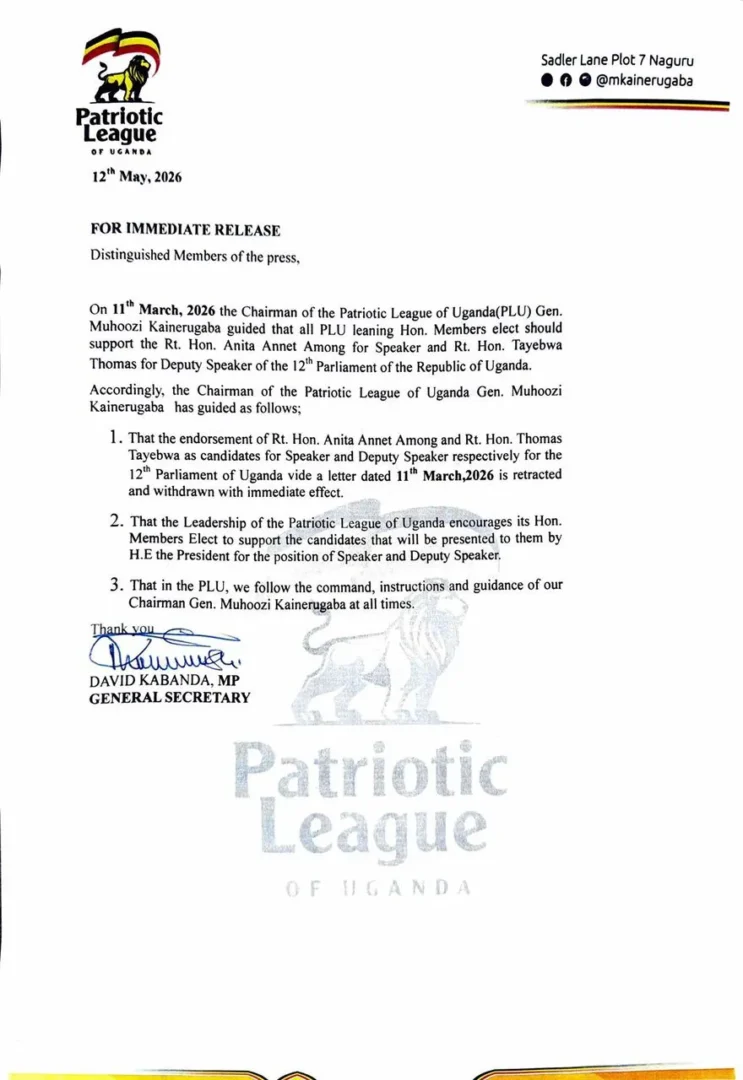
In a statement dated May 12, 2026, signed by PLU Secretary General Daudi Kabanda, the movement said its earlier directive backing the two leaders had been rescinded following guidance from its chairman, Gen Muhoozi Kainerugaba.
“That the endorsement of Rt. Hon. Anita Annet Among and Rt. Hon. Thomas Tayebwa as candidates for Speaker and Deputy Speaker respectively for the 12th Parliament of Uganda via a letter dated 11th March, 2026 is retracted and withdrawn with immediate effect,” the statement reads.
The document further directed PLU MPs-elect to align with candidates to be presented by Yoweri Kaguta Museveni for the two top parliamentary positions.
“That the leadership of the Patriotic League of Uganda encourages its Hon. Members Elect to support the candidates that will be presented to them by H.E the President for the position of Speaker and Deputy Speaker.”
Gen Muhoozi signals shift in power dynamics
The official withdrawal confirms mounting speculation after Muhoozi posted a series of cryptic and increasingly pointed messages on X distancing himself from the earlier endorsement.
“We have another candidate…call him/her the PLU candidate,” he wrote, triggering intense debate within Kampala’s political circles.
He later added: “PLU supports whatever position President Museveni takes and we do not listen to NRM’s CEC,” before declaring that “NRM CEC decisions that are against the will of the Chairman are null and void.”
Within Uganda’s ruling establishment, Gen Muhoozi’s statements carry significant weight, reflecting his expanding political influence through PLU, a movement that has built support among younger MPs and MPs-elect.
Race reopened after Kyankwanzi signal
The reversal represents a major setback for Among and introduces fresh uncertainty around Tayebwa’s position, both of whom had appeared firmly in control after endorsement by the National Resistance Movement’s Central Executive Committee.
However, President Museveni effectively reopened the race during the NRM retreat in Kyankwanzi, stating that the Speaker issue would be addressed “at the right time” — a signal widely interpreted as a pause rather than a confirmation.
That intervention shifted internal party calculations, with factions recalibrating their positions in anticipation of the president’s eventual endorsement.
Rolls Royce controversy fuels political pressure
The political shift comes amid heightened scrutiny surrounding reports that Among recently acquired a Rolls Royce said to be worth approximately Shs3.4 billion.
Although she reportedly maintained that the vehicle was a gift, the development sparked widespread criticism online, with many Ugandans questioning the optics of such luxury at a time of economic strain.
Also Read: Anita Among’s Speakership re-election bid shaken after Gen Muhoozi’s explosive remarks
Gen Muhoozi appeared to reference the controversy in one of his most widely circulated posts: “I have been Mzee’s son for 52 years but I have never sat in a rolls royce ever. I don’t think Mzee has sat in one either.”
He followed with a strongly worded statement: “Our job is to SERVE Ugandans not ourselves! I cannot support corruption! I risked my life to make this country peaceful. Now that it is, it will not be taken by thieves. Never!”
Who Next? Succession calculus intensifies
With the contest effectively reset, attention has now shifted to potential alternative candidates and the role of State House in shaping the outcome.
Political insiders suggest Tayebwa still commands considerable support within Parliament. However, other figures are emerging in the background, including Defence Minister Jacob Oboth Oboth, who is viewed by some as a possible compromise candidate capable of bridging political and security interests.
The developments underscore a broader trend within Uganda’s political system, where formal party processes increasingly intersect with personalised centres of influence, particularly around the presidency and the First Family.
As the contest evolves, the Speaker race is no longer a routine parliamentary transition but a key test of power alignment within the ruling establishment.