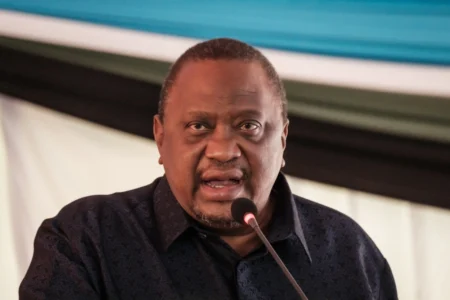


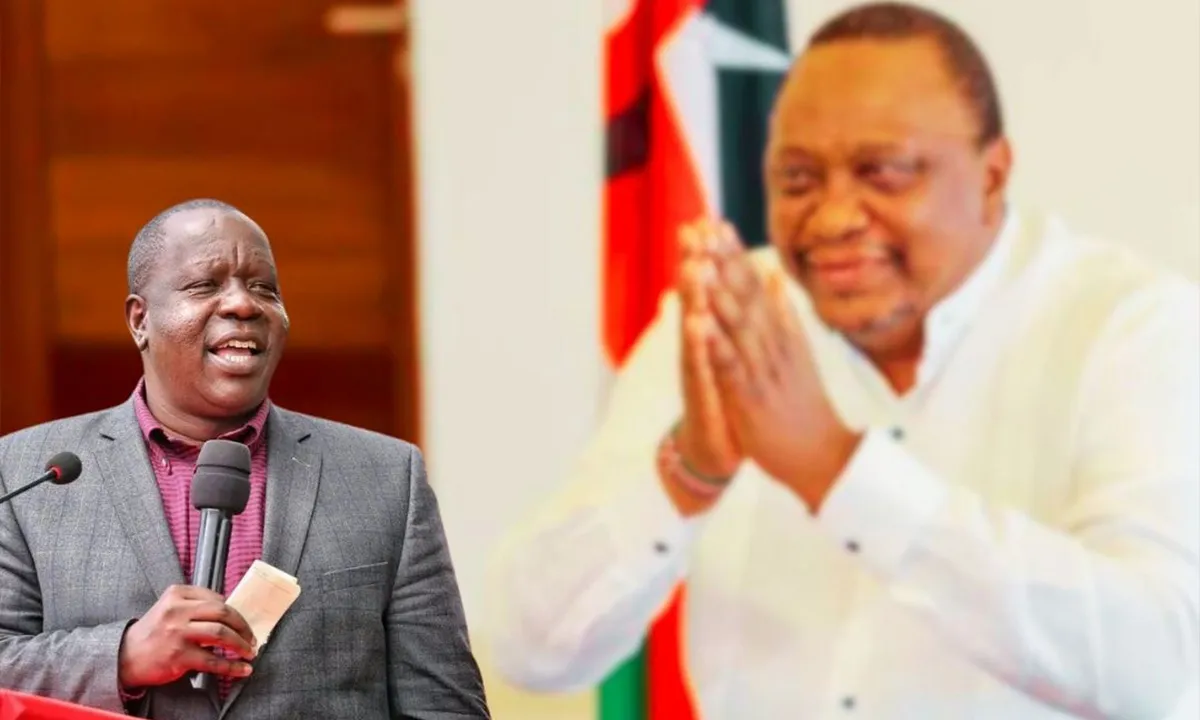
NAIROBI, Kenya — A fresh political dispute has emerged in Kenya over the retirement benefits of former presidents, after Jubilee deputy party leader Fred Matiang’i mounted a robust defence of Uhuru Kenyatta, insisting that his entitlements are constitutionally guaranteed and should not be subjected to political pressure.
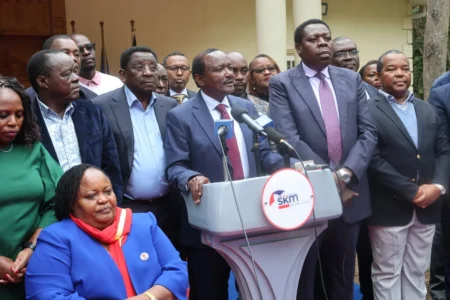
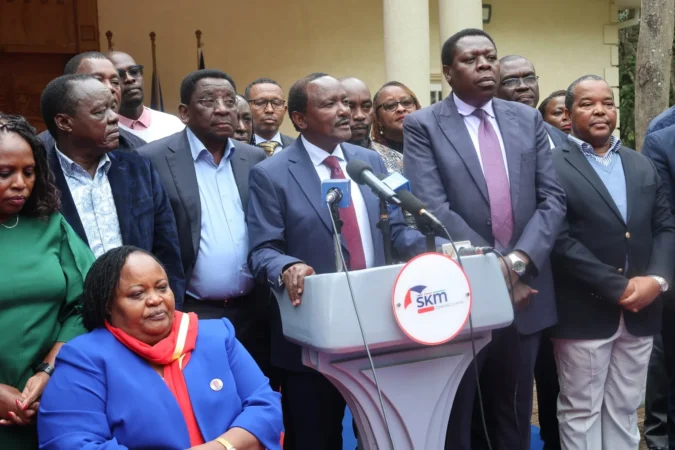
Speaking during a press conference on Monday, Matiang’i argued that the legal framework governing presidential retirement is explicit, cautioning against what he described as attempts to politicise provisions anchored in law.
“The Constitution says what he should get and how he should be treated,” Matiang’i said.
The remarks come amid a growing controversy sparked by a motion tabled by Samson Cherargei, who is seeking to review, reduce, or revoke benefits allocated to the former president.
In the proposal before the Senate, Cherargei calls for Parliament to reassess public spending tied to Kenyatta’s retirement package, including a directive for the Auditor-General to conduct a comprehensive audit within 60 days.
“…. the House recommends that any funds recovered from benefits previously accorded to the retired President shall be redirected to serve the interests and welfare of the people of Kenya,” the motion states in part.
The move has intensified an already charged political atmosphere, with the issue increasingly intersecting with broader power dynamics and alignments ahead of the 2027 general election cycle.
Matiang’i framed the debate as a test of institutional integrity, warning that failure to honour legally defined benefits for a former head of state could undermine respect for constitutional offices.
“When the President cannot even be given basic benefits, he is a gentleman and does not want to focus on them. It is upon the conscience of those in leadership to respond to the question,” he added.
He further described Kenyatta as restrained in his response, suggesting that the former president has deliberately avoided escalating the matter publicly despite concerns over the implementation of some entitlements.
“The President has been receiving some of his benefits. He is a gentleman. There are some things that we do not want to play up, as someone who served at a senior level,” he said.
At the centre of the dispute is Kenya’s Presidential Retirement Benefits Act, which outlines the privileges accorded to former heads of state, including security, pensions, and logistical support.
The law envisions retired presidents as largely non-partisan figures who may provide advisory roles to the nation, rather than actively participate in frontline politics.
However, recent political developments have complicated that framework.
Kenyatta’s continued involvement in national politics, including his endorsement of Matiang’i during a Jubilee event in Narok, has drawn criticism from allies of President William Ruto, who argue that active political engagement raises questions about the scope and justification of state-funded benefits.
Also Read: Moses Kuria urges Luo community to reject ‘devil narrative’ against Uhuru Kenyatta
Legal analysts note that any attempt to alter retirement benefits through parliamentary action could set a far-reaching precedent affecting future presidents, raising concerns about the stability and predictability of constitutional guarantees.
At the same time, proponents of reform argue that public accountability must extend to all recipients of state resources, particularly in a context of economic strain and rising public scrutiny over government expenditure.
The unfolding debate therefore reflects a deeper tension between constitutional protections and evolving political realities, one that could ultimately require judicial interpretation if legislative action proceeds.
As the Senate considers the motion, attention is likely to shift toward whether the matter will remain a political contest or evolve into a constitutional dispute with potential court intervention.
For now, the issue has reignited debate over the balance between law, leadership, and accountability in Kenya’s governance framework, placing the role and privileges of former presidents firmly back into the national spotlight.