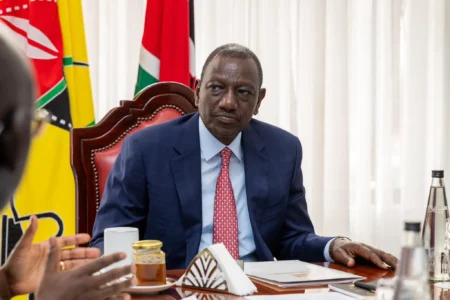


NAIROBI, Kenya — President William Ruto has explained the origins of the nickname “Zakayo,” linking it to public backlash over his administration’s tax policies and flagship housing programme.
Speaking during a meeting with Kenyans living in Italy, the President said the label emerged at the height of criticism surrounding the rollout of the Affordable Housing Programme and the introduction of new levies to finance it.
“That is how I became Zakayo,” the President said, reflecting on the resistance he faced when the policy was unveiled.
“When I pushed for the housing programme, many citizens, leaders actually, said, ‘ Who told you that Kenyans need houses? People have their homes, why are you obsessed with this programme?” he said.
The Affordable Housing Programme remains one of the government’s most ambitious policy pillars, aimed at addressing Kenya’s housing deficit while creating employment opportunities.
President Ruto argued that despite longstanding political promises, previous administrations had failed to implement housing projects at scale.
“You see, the irony is that in every manifesto of every political party in the last 25 years, housing has always been a permanent feature,” he said.
The President cited progress under the initiative, pointing to job creation and ongoing construction projects across the country.
“Today, in our housing ecosystem, we have 640,000 Kenyans who are working. We have 210 sites of affordable housing and 600 sites of markets,” Ruto said.
He added that some beneficiaries had already begun receiving completed units.
“We are doing 240,000 housing units. We have started giving out keys, and we have hostels for 180,000 college students,” he said.
Central to the controversy has been the introduction of the Housing Levy under the Finance Act 2023, which imposed additional deductions on salaried workers to fund the programme.
Ruto defended the decision as necessary to unlock large-scale development.
“It was deliberate, but it was difficult, and that is how I became Zakayo. We had to have the Housing Levy,” he said.
The nickname “Zakayo,” derived from the biblical tax collector Zacchaeus, gained traction online and in political discourse as criticism grew over rising taxes and the cost of living.
Also Read: President Ruto expresses amusement and concern over Zakayo, Kasongo nicknames
Opposition figures and social media users widely adopted the term as a symbol of frustration with fiscal policies, particularly those affecting fuel, housing and essential goods.
The debate over taxation comes amid broader economic pressures, including inflation, currency volatility and rising global commodity prices.
While the government maintains that its reforms are necessary to stabilise public finances and drive long-term growth, critics argue that the cumulative tax burden has strained households and businesses.
The housing programme itself remains a cornerstone of the administration’s economic strategy, framed as both a social intervention and a job creation engine within Kenya’s construction sector.
As implementation continues, the policy, and the nickname it inspired, has become emblematic of the broader tension between fiscal reform and public acceptance.