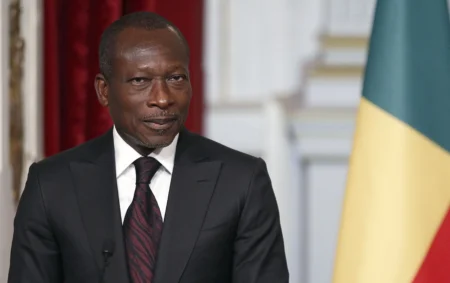
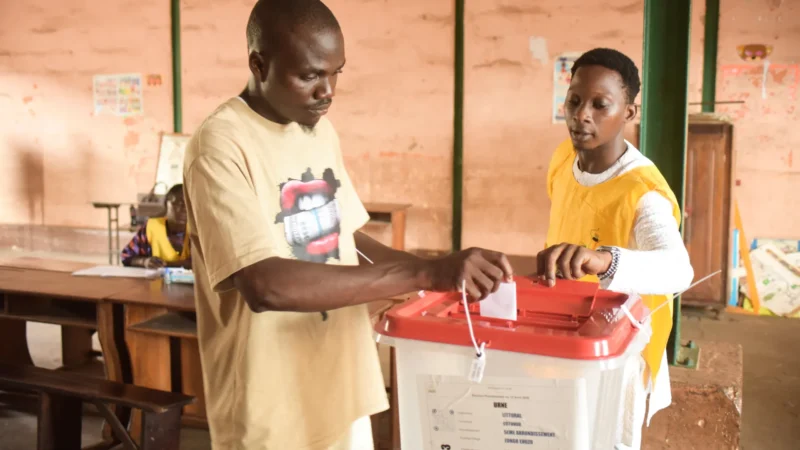



COTONOU, Benin — Voters in Benin went to the polls on Sunday to elect a successor to President Patrice Talon, who is stepping down after 10 years in power, leaving behind a record marked by economic growth, tightening political controls and mounting security challenges.
The election is widely seen as a test of the country’s democratic credentials in a region increasingly affected by political instability and military takeovers.
Finance minister Romuald Wadagni, 49, is the candidate of the ruling coalition and is widely viewed as Talon’s preferred successor for the seven-year term. He faces a challenge from Paul Hounkpè, the sole opposition candidate.
Nearly eight million voters are registered across more than 17,000 polling stations nationwide. With a population estimated at over 15 million, Benin, like many countries in sub-Saharan Africa, has a predominantly young electorate.
Polling stations opened in a subdued atmosphere, with early reports indicating low turnout in parts of the country, including the commercial capital, Cotonou. Public demonstrations were banned on election day, although businesses and daily activities continued largely uninterrupted.
Results are expected within 48 hours after polls close.
Analysts say the election outcome may already be largely predetermined following January’s parliamentary polls, which left pro-government parties in full control of the National Assembly after opposition groups failed to meet a 20% electoral threshold required to gain representation.
Critics argue that electoral rules have effectively narrowed political competition. Prominent opposition figures, including Renaud Agbodjo of the Democrats party, were barred from contesting after failing to secure the required parliamentary endorsements, conditions opposition groups say were designed to exclude challengers.
Wadagni has campaigned on Benin’s economic performance during his tenure as finance minister, highlighting steady growth and fiscal reforms.
Benin’s economy expanded by around 7% in 2025, positioning it among the stronger performers in West Africa.
“Ten years at the Finance Ministry have given him something rare in African politics: a quantified record, verifiable and difficult to dismantle in a serious debate,” said Fiacre Vidjingninou, a political analyst at the Lagos-based Béhanzin Institute.
Despite its long-standing reputation as one of West Africa’s more stable democracies, Benin has faced increasing criticism from rights groups.
Organizations such as Amnesty International and Human Rights Watch have accused the Talon administration of restricting political freedoms, citing arrests of opposition figures, limits on public demonstrations and pressure on independent media.
In recent years, protests linked to rising living costs have been met with firm responses from security forces, further fuelling concerns about shrinking civic space.
Beyond politics, security remains a growing concern.
Also Read: France provided surveillance, logistical support in countering Benin coup attempt
In December, Benin experienced a failed coup attempt, reflecting a broader pattern of attempted military takeovers across parts of Africa.
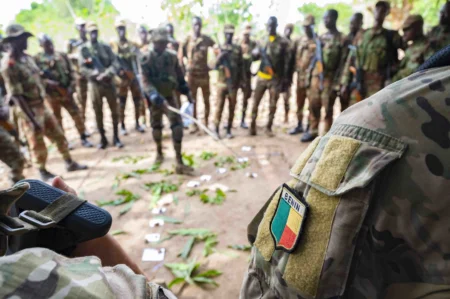
The country has also faced increasing insecurity in its northern regions, driven by spillover violence from neighbouring Burkina Faso and Niger, where jihadist insurgencies have intensified.
Militant groups linked to Jama’at Nusrat al-Islam wal-Muslimin (JNIM), an al-Qaeda-affiliated network, have extended their reach into border areas, complicating security efforts.
Analysts warn that limited regional cooperation, particularly with neighbouring countries now under military rule, has further strained efforts to contain the insurgency.
As votes are counted, the election represents a critical juncture for Benin, balancing economic progress with political openness and security stability.
The outcome is expected to shape not only the country’s domestic trajectory but also its standing in a region grappling with democratic backsliding and rising insecurity.