


KUWAIT CITY, Kuwait — The United States military has identified the first American service members killed since Washington launched coordinated strikes on Iran alongside Israel, marking a significant escalation in the widening regional conflict.
Six US troops died after what officials described as an “unmanned aircraft system” penetrated air defences and struck a command facility in Port Shuaiba, Kuwait, on Sunday.
Initially, US Central Command reported three fatalities. However, by Monday the death toll had risen to six after one service member died from injuries and two additional bodies were recovered from the rubble.
They are the only confirmed American combat fatalities since the United States entered the current phase of hostilities with Iran.
Those identified
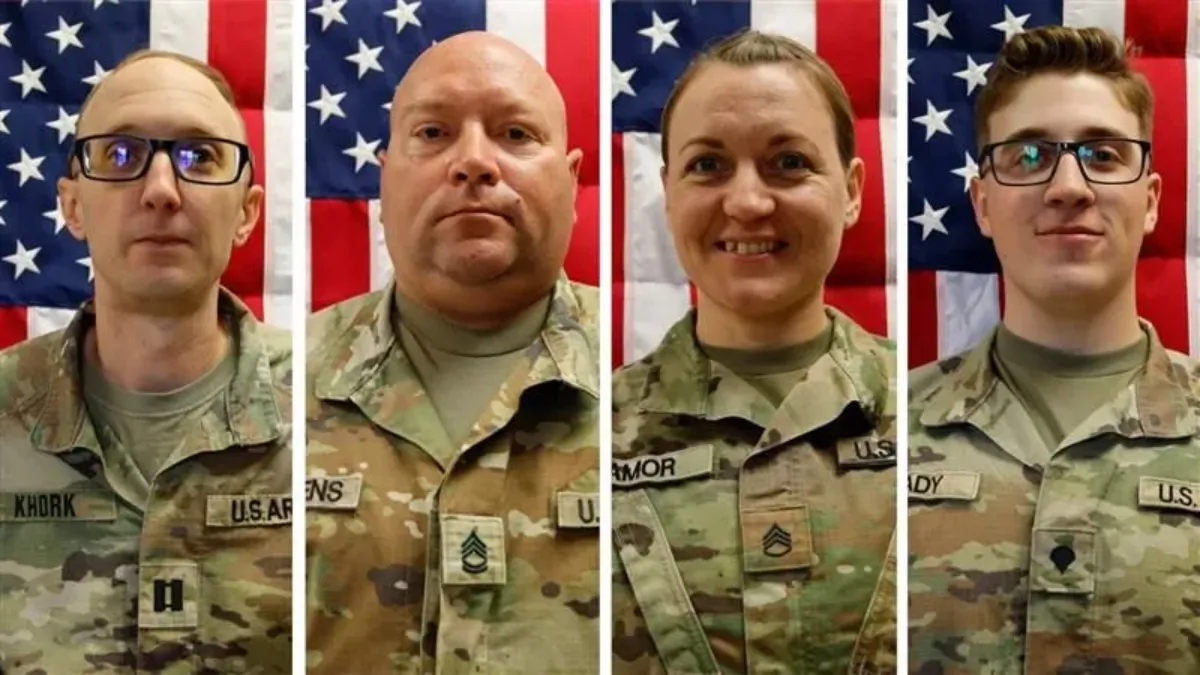
Four of the deceased; all US Army Reserve soldiers, were publicly named on Tuesday:
- Capt Cody Khork, 35
- Sgt Noah Tietjens, 42
- Sgt Nicole Amor, 39
- Sgt Declan Coady, 20
Capt Khork, from Florida, had previously deployed to Saudi Arabia, Guantanamo Bay and Poland. Sgt Amor, of Minnesota, had served in Kuwait and Iraq. Sgt Tietjens, from Nebraska, had completed two prior deployments to Kuwait. All three were described by the military as decorated service members.
Sgt Coady, an Iowa resident, was posthumously promoted from specialist. He enlisted in the Army Reserve three years ago.
The names of the remaining two service members have not yet been released, pending notification of next of kin.
Questions over fortification
Speaking on Monday, US Defence Secretary Pete Hegseth said a “powerful weapon” had struck a “tactical operations centre that was fortified”.
However, three US officials with direct knowledge of the attack told CBS News that personnel had been operating from a temporary office structure.
According to those officials, a trailer was being used as a workspace, shielded by 12-foot (3.7m) steel-reinforced concrete barriers.
The disclosures have prompted questions about whether protective measures were adequate in a region facing heightened drone and missile threats.
Strategic context
The strike took place at a facility in Kuwait, a long-standing US security partner that hosts more than 13,000 American troops.
The Gulf state has served as a key logistics and command hub for US military operations in the Middle East for decades.
Iran has intensified retaliatory attacks across the region following US and Israeli strikes on Iranian targets.
In recent days, missile and drone launches have targeted US-linked facilities and infrastructure in Bahrain, the United Arab Emirates, Saudi Arabia, Oman and Qatar, according to regional authorities.
The use of unmanned aerial systems reflects a broader shift in regional warfare tactics. Iran and its allied groups have invested heavily in drone capabilities over the past decade, enabling precision strikes at relatively low cost and with reduced exposure of personnel.
Separate ‘friendly fire’ incident
In a separate development, the US military confirmed that three fighter jets were lost in what it described as a “friendly fire” incident over Kuwait on Monday.
Video circulating online showed aircraft spiralling towards the ground. All pilots ejected safely and survived.
Iranian state media claimed Iranian forces had shot down the jets, though no evidence has been provided to support that assertion.
Also Read: UK announces first evacuation flight from Middle East
The deaths mark a critical moment in the rapidly evolving confrontation between Washington and Tehran.
While the US has conducted military operations in the region for years, confirmed fatalities directly linked to the current escalation underscore the risk of a wider regional war.
Analysts say further retaliatory exchanges remain possible, particularly involving drone and missile attacks on Gulf-based US facilities.
Regional airspace disruptions, maritime security alerts in the Gulf, and rising global oil prices reflect the broader economic and geopolitical fallout.
US officials have not indicated whether additional troop deployments or defensive reinforcements are planned.