


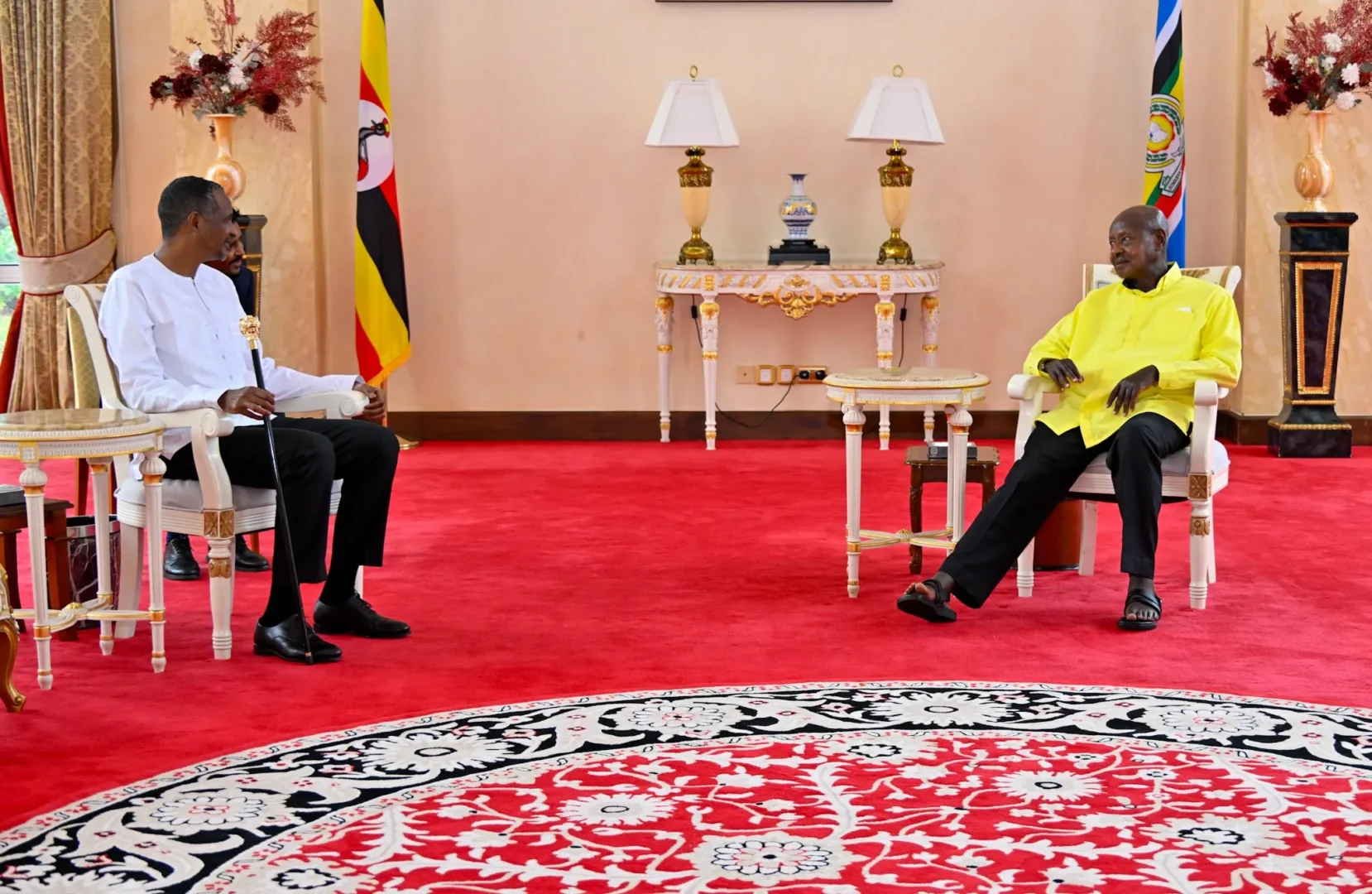
KHARTOUM, Sudan — Sudan’s army-aligned government has criticised Uganda after President Yoweri Museveni hosted paramilitary commander Mohamed Hamdan Dagalo, widely known as Hemedti, describing the meeting as an “affront to humanity”.
Dagalo, the leader of Sudan’s Rapid Support Forces (RSF), met Museveni at State House in Entebbe on Friday, a day after a United Nations investigation accused RSF fighters of committing acts amounting to genocide in Darfur.
Sudan’s foreign ministry said the reception undermined international condemnation of alleged atrocities by the paramilitary group, noting that the RSF’s actions had been documented by global observers and denounced by regional blocs including the African Union and the Intergovernmental Authority on Development (IGAD).
Dagalo defended his visit, saying he travelled to Uganda after the Sudanese army requested Museveni’s mediation in the conflict that has devastated the country since April 2023.
His trip followed a separate meeting between Museveni and Malik Agar, deputy to Sudan’s army chief Abdel Fattah al-Burhan within the Transitional Sovereignty Council, highlighting Kampala’s engagement with both sides of the war.
Addressing supporters, Dagalo reiterated his preference for African-led negotiations.
“From the first day of the war, we said negotiations must be African. Peace should be made in Africa: IGAD and the African Union,” he said.
Efforts to broker a ceasefire have repeatedly collapsed. A proposal backed by the United States and Saudi Arabia remains under review by Sudan’s military leadership, while talks mediated by the so-called Quad, comprising the US, United Arab Emirates, Saudi Arabia and Egypt, have stalled.
Burhan has accused the group of favouring the UAE, which Sudan alleges is supporting the RSF, claims Abu Dhabi denies.
The Entebbe meeting marked Dagalo’s second engagement with Museveni, following a regional tour in late 2023 that analysts viewed as an attempt to gain diplomatic legitimacy.
Dagalo has since declared a rival administration in Darfur, though it has not received international recognition, a move that has deepened fears of Sudan’s fragmentation.
During his speech, the RSF commander described the war as an “existential” struggle and vowed victory. He claimed his forces would have captured Khartoum and Port Sudan “if it weren’t for drones from neighbouring countries,” referencing reports that Egyptian and Turkish strikes disrupted RSF supply routes.
Dagalo also said RSF troop numbers had expanded dramatically, from about 160,000 fighters at the start of the conflict to roughly half a million, figures that remain difficult to independently verify.
Meanwhile, fighting near the Blue Nile border has raised fears that the war could widen, potentially drawing in neighbouring states and opening new fronts.
Also Read: Sudan’s RSF paramilitaries bows to US pressure, agrees to humanitarian ceasefire
The conflict between the Sudanese army and the RSF has created what aid agencies describe as the world’s largest displacement and hunger crisis.
Since the war began in April 2023, tens of thousands of people have been killed and more than 11 million displaced, with famine risks rising across multiple regions.
Analysts say Museveni’s engagement with both camps reflects a broader regional effort to position African actors at the centre of peace negotiations.
However, Sudan’s government reaction illustrates the diplomatic sensitivities surrounding any perceived legitimisation of armed groups accused of mass atrocities.
