


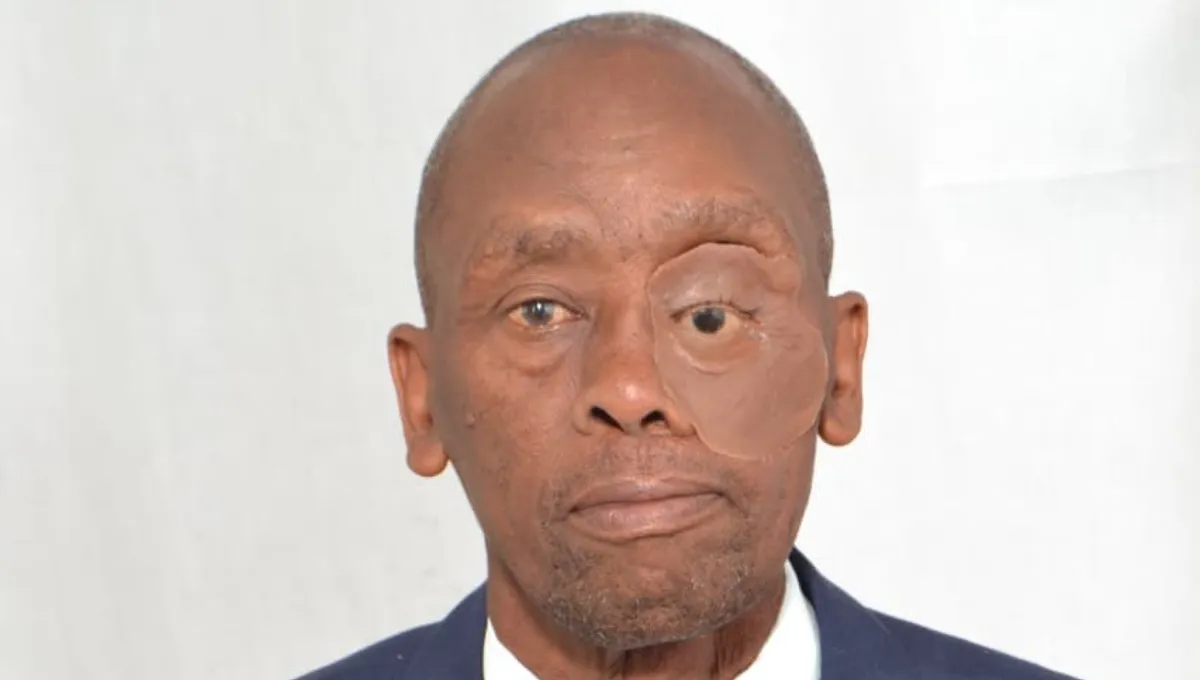
NAIROBI, Kenya — Kenyatta National Hospital (KNH) has achieved a landmark in Kenya’s public healthcare system by successfully fitting the country’s first orbital-facial prosthesis in a government facility. The complex reconstructive intervention has restored both function and confidence to a cancer survivor who had lived with visible facial disfigurement for nearly four years.
The recipient, 65-year-old Mr John Munyiri, a farmer from Laikipia County, began experiencing persistent nasal blockage in 2022, a symptom that later developed into a diagnosis of maxillary carcinoma, an aggressive cancer affecting the sinus and upper jaw region. As the disease progressed, it caused severe facial swelling, including a painful and watery left eye.
In a statement, KNH said that after months of worsening symptoms, Munyiri was referred to the national referral facility where he underwent 25 sessions of radiotherapy aimed at containing the tumour.
When the cancer did not fully respond, surgeons performed radical surgery in June 2023. The procedure involved removal of his left eye, part of his nose and sections of his upper jaw, a life-saving but disfiguring intervention.
Although declared cancer-free, Munyiri faced profound physical and psychological challenges. Basic activities such as eating, speaking and sleeping became difficult.
He returned to his rural home wearing an eye patch, which he later described as a constant reminder of his ordeal, attracting unwanted attention and diminishing his confidence.
Multidisciplinary innovation
The hospital’s Maxillofacial and Prosthodontics teams embarked on a phased rehabilitation plan. Initially, Munyiri was fitted with a customised maxillary obturator, a prosthetic device designed to seal the opening between the oral and nasal cavities created by surgery. This was followed by dentures and structured speech therapy to restore oral function.
However, the visible orbital defect remained a source of emotional strain.
In June 2025, a multidisciplinary team comprising Dr Samuel Okerosi (Consultant ENT and Head & Neck Surgeon), Dr Margaret Mwasha (Consultant Prosthodontist), Dr Andrew Okiriamu (Consultant Oral and Maxillofacial Surgeon), and Dental Technologist Mr John Kariuki designed and fabricated a three-piece, magnet-retained orbital-facial prosthesis.
The device, anchored using precision magnets for improved stability and comfort, was successfully fitted in January 2026. According to KNH, this marks the first time such an advanced facial prosthesis has been delivered within Kenya’s public health system, a development that expands access to highly specialised reconstructive care that has traditionally been limited to private facilities or overseas treatment.
Advancing Public Oncology Care
Head and neck cancers account for a significant portion of cancer-related morbidity in Kenya, with late diagnosis often resulting in extensive surgical interventions.
Specialists note that while tumour removal remains the primary objective, post-surgical rehabilitation, particularly facial prosthetics, plays a critical role in restoring quality of life.
Orbital-facial prostheses are custom-designed artificial replacements used after removal of the eye and surrounding structures.
Also Read: Kenyan doctors save two-year-old boy after choking on groundnuts without surgery
They require close collaboration between surgeons, prosthodontists and technologists to ensure anatomical accuracy, durability and cosmetic realism.
For Munyiri, the outcome has been transformative. The prosthesis has restored facial symmetry, eliminated the need for an eye patch and significantly improved his social interactions.
Today, he has resumed farming in Laikipia, speaks clearly, eats comfortably and participates in community life without the stigma he once faced.
Healthcare analysts say the procedure reflects growing capacity within Kenya’s public hospitals to deliver advanced reconstructive and oncological services locally, reducing the need for medical travel abroad and lowering costs for patients.
For KNH, the case signals not only a surgical milestone, but a broader shift towards holistic cancer care, one that prioritises both survival and dignity.
