


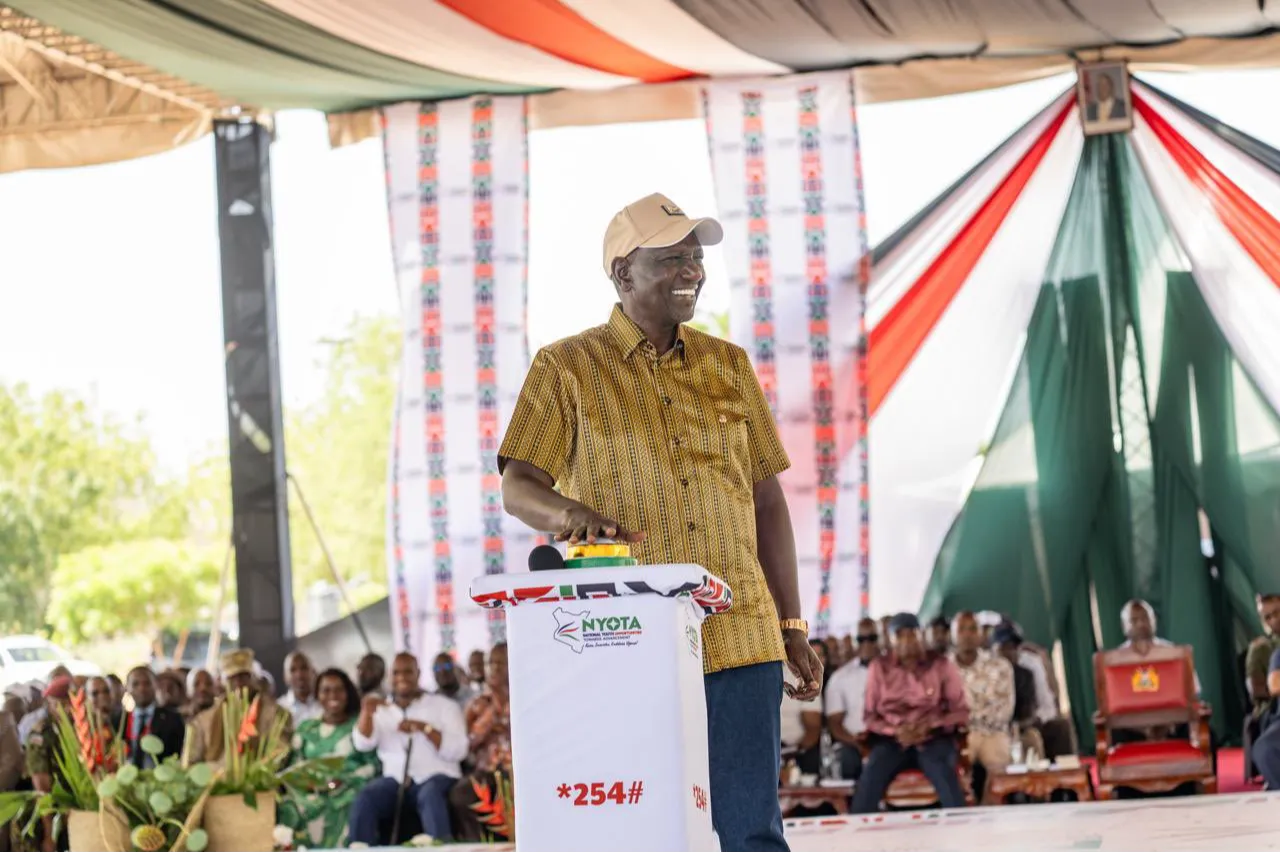
MANDERA, Kenya — President William Ruto has dismissed allegations by the United Opposition that he held secret meetings with al-Shabab-linked individuals during a recent visit to Kenya’s Northeastern region.
Speaking during a development tour, the President described the claims as divisive and politically motivated, insisting that his administration remains focused on national unity and inclusive development.
“Sijui watafanya nini wale [United Opposition]. Wakati nilikuja hapa, walisema nimekuja kukutana na al-Shabab… So I want to tell you the people of northern Kenya we are moving together,” he said.
To reinforce his message of inclusion, Ruto announced that this year’s Madaraka Day celebrations will be hosted in the Northeastern region — a symbolic first for the area.
“For the first time tutaleta mambo ya Madaraka hapa northern Kenya. Mwezi wa sita mwaka huu… In the month of June, we will celebrate the National Independence Day,” Ruto said.
“We are building one of the longest and most comprehensive roads in Kenya – 750km Isiolo-Mandera road at a cost of KSh100 billion – to demonstrate our commitment to developing every part of our country. Under our leadership, we will correct the past of marginalisation and discrimination, and rewrite a future of transformation that leaves no Kenyan, no region and no community behind,” Ruto added.
Madaraka Day, observed annually on June 1, commemorates Kenya’s attainment of internal self-rule in 1963.
Hosting the national celebration in Northeastern Kenya would mark a significant political gesture, given the region’s long-standing security challenges and historical marginalisation.
Opposition allegations
The controversy stems from remarks made in August last year by former Deputy President Rigathi Gachagua, who alleged that Ruto had held closed-door meetings with unidentified individuals during a visit to Mandera. He further claimed that the government had scrapped security vetting procedures in the region, a policy historically criticised by human rights groups as discriminatory.
Gachagua also linked the alleged meetings to al-Shabab sympathisers during remarks made while on a tour of the United States.
The government has not indicated any policy shift that would compromise counterterrorism operations, and Kenya remains a key regional ally in the fight against al-Shabab, the Somalia-based militant group responsible for multiple attacks in Kenya over the past decade.
Local leaders respond
Mandera Senator Ali Roba rejected the allegations, stating that he accompanied the President throughout the visit and that all engagements were conducted publicly.
“As a leader who personally accompanied President William Ruto from the moment he landed in Mandera to the moment he departed, I can confirm that the President’s engagements were transparent and within public domain,” said Roba.
He added that the itinerary had been published in advance and denied the existence of private or unscheduled meetings.
Also Read: Deadly al-Shabab ambush kills 6 Kenyan police officers near Somali border
Roba also addressed the issue of security vetting, noting that the President had reiterated his administration’s commitment to ending what he described as discriminatory practices affecting border communities, while maintaining national security safeguards.
Security and political context
Northeastern Kenya has historically faced heightened security scrutiny due to its proximity to Somalia and past cross-border militant activity.
Security vetting policies in the region have drawn criticism from civil society organisations, which argue that collective suspicion has undermined trust between communities and the state.
Kenya continues to participate in regional counterterrorism efforts, including cooperation with the African Union Transition Mission in Somalia (ATMIS) and intelligence-sharing arrangements aimed at preventing extremist recruitment and cross-border attacks.
Ruto’s announcement to host Madaraka Day in the region is likely to carry both symbolic and political weight, positioning the move as part of a broader effort to integrate historically marginalised areas into the national development agenda.
