


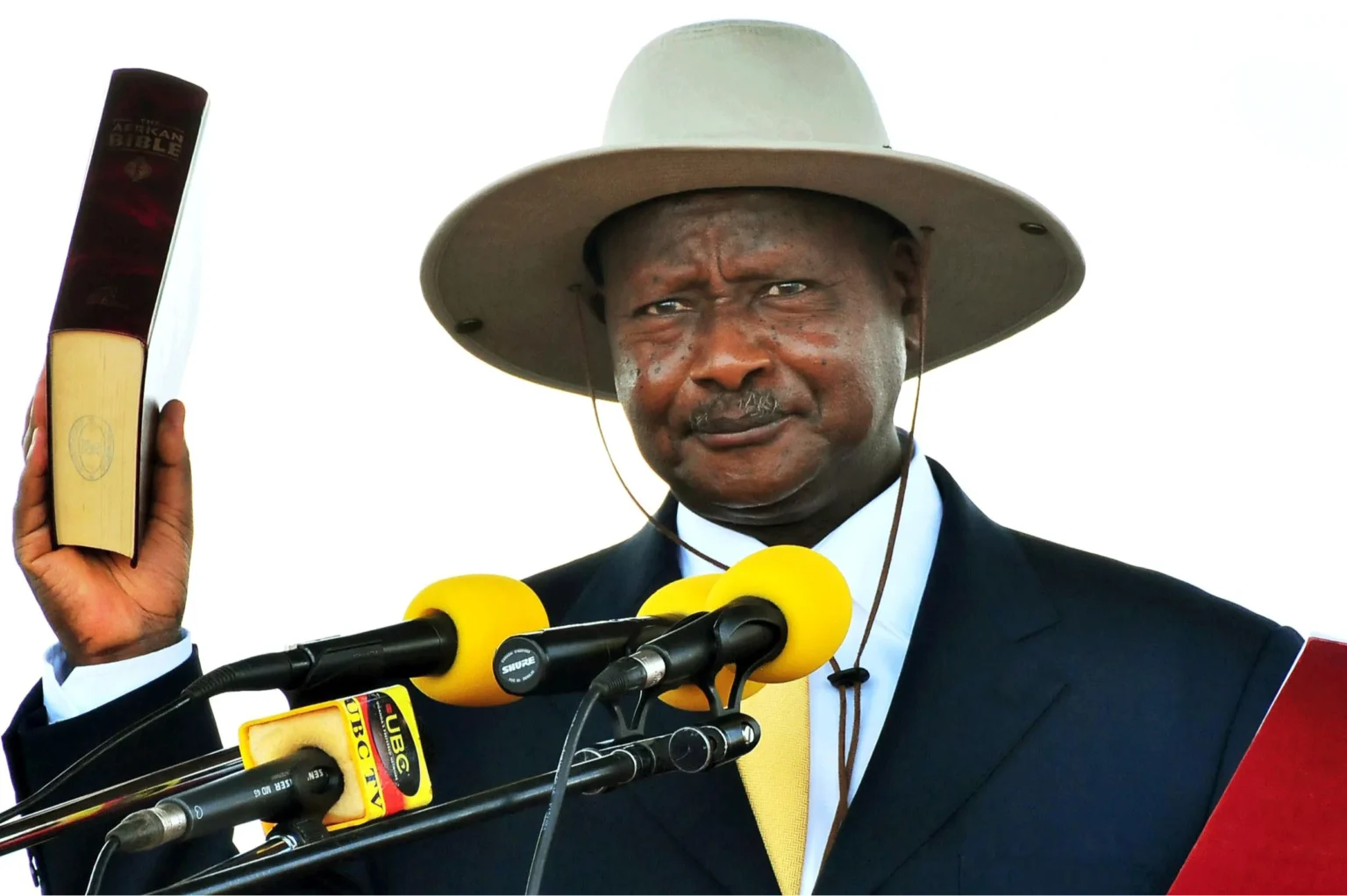
KAMPALA, Uganda — As President Yoweri Kaguta Museveni seeks a seventh term in office, his appeal to Ugandan voters is increasingly anchored not in liberation credentials or ideology, but in economic performance and long-term transformation. Growth statistics, infrastructure investment, financial stability and structural reform now form the core of his re-election message.
“At the beginning, we had almost nothing,” Museveni said during his nomination as the National Resistance Movement (NRM) presidential candidate for the 2026–2031 term. “Today, Uganda’s GDP has doubled in the recent kisanja, from $34 billion to $66 billion.”
To the president, this expansion reflects a deliberate, state-led development strategy: political stabilisation, heavy investment in infrastructure, expansion of the money economy, and the attraction of domestic and foreign capital.
From economic ruin to market reform
When Museveni took power in 1986, Uganda’s economy was emerging from years of conflict, hyperinflation and financial repression.
According to Bank of Uganda Governor Michael Atingi-Ego, the financial system itself had become a brake on growth.
“The country was coming from shackles of financial repression,” Atingi-Ego said. “Rampant inflation, a contracting productive base, low tax revenue, and a financial system that was more a barrier than a bridge to progress.”
Interest rates were state-controlled, credit was politically directed, and monetary policy was subordinated to short-term fiscal pressures, fueling inflation and undermining confidence.
That trajectory shifted sharply in the early 1990s, when the government embarked on market-oriented reforms, liberalising interest rates, opening the foreign exchange market and, in 1997, liberalising the capital account.
“These were not cosmetic changes,” Atingi-Ego said. “They were a liberation of the economy.”
Opening the capital account, he noted, forced fiscal discipline and macroeconomic consistency, or risked capital flight. The reforms signalled Uganda’s openness to investment, drawing foreign capital, technology and skills.
A defining moment was the controversial privatisation of Uganda Commercial Bank (UCB) in 2002. At the time, UCB—then the country’s largest state-owned bank, was technically insolvent, weighed down by non-performing loans and political interference.
“UCB had become a living embodiment of the problems of the past,” Atingi-Ego said.
While critics still question the sale to Stanbic Bank, the central bank maintains that it stabilised the financial sector and halted the inflationary cycle driven by repeated government bailouts.
Debt, infrastructure and the growth debate
Museveni’s economic model relies heavily on public investment, particularly in energy and transport. Secretary to the Treasury Ramathan Ggobi has defended the government’s borrowing, arguing that debt has largely financed productive sectors.
“About 27 percent of the money borrowed in the last ten years has gone into energy development,” Ggobi said, citing investments in dams, transmission lines and substations. A further 13 percent, he added, has been directed to education, health, housing, manufacturing and digital transformation, with the remainder funding agro-industrialisation, irrigation, natural resources and water access.
“Uganda’s debt has grown mainly in productive areas,” Ggobi argued, insisting that rising exports and revenues have kept debt servicing manageable. Uganda, he said, will not default.
Museveni’s current economic ambition is framed around the Ten-Fold Growth Strategy, outlined in National Development Plan IV (NDP IV). The goal is to expand the economy from roughly $50 billion to $500 billion by 2040, driven by agro-industrialisation, tourism, mineral development, including oil and gas—and science, technology and innovation.
The finance constraint
For the Bank of Uganda, however, the success of that vision hinges on access to long-term finance.
“A shallow river cannot carry heavy boats,” Atingi-Ego warned.
Although Uganda’s financial markets are now ranked among Africa’s more developed, they remain too shallow to finance large-scale infrastructure and long-horizon industrial projects. Commercial banks, he notes, are structured for short-term lending, not decade-long investments.
High interest rates, long criticised by businesses, are acknowledged by the central bank. Atingi-Ego attributes them to high operating costs, government borrowing, structural credit constraints and limited pools of long-term capital.
To address this, the Bank of Uganda is pushing pension sector reforms, deeper capital markets and new instruments such as infrastructure bonds, green bonds, Sukuk bonds and diaspora bonds.
“Government alone cannot finance the tenfold growth,” he said. “We need to unlock domestic and long-term capital.”
Risks, markets and surplus
Despite official optimism, risks remain. Ggobi points to regional insecurity, climate change and global trade tensions as external threats. Domestically, corruption, climate shocks and weak market integration persist.
Museveni himself acknowledges that growth has produced new challenges, particularly surplus production without sufficient markets.
“Our problem now is not a shortage,” he has said. “It is surplus.”
His solution lies in deeper regional integration, expanded domestic purchasing power and improved access to external markets.
Ultimately, Museveni’s economic case for a seventh term is a bet on continuity: that the leadership which stabilised the economy can complete the transition from subsistence to a fully monetised, industrial system.
Power, continuity and the cost of order
Museveni, now in his early 80s, rejects the argument that long rule equals stagnation. Instead, he frames his leadership as a continuous historical struggle.
“I have been in the struggle for 60 years,” he once told German journalists. “Student movement. Liberation struggle. Now government. For us, it is the same struggle.”
Also Read: Love him or loathe him: Museveni’s 40 years in power and the battle to ‘Protect the Gains’
Critics accuse him of entrenching power through constitutional amendments, arrests, internet shutdowns and heavy security deployments during elections. Museveni counters that order is often mischaracterised as repression.
“Democracy means choice,” he insists. “And there is choice here.”
He has similarly downplayed corruption allegations, arguing that sustained growth proves the system is not crippled.
“If corruption was so overwhelming,” he asks, “how is it that our economy is growing very fast?”
A counter-narrative emerges
Political economist Professor Julius Kiiza offers a sharp counterpoint, warning that macroeconomic stability masks deep inequalities.
“Yes, there is growth—but it is jobless growth. Sixty-seven percent of our youth, especially graduates, remain unemployed. The economy serves elites and foreign interests more than ordinary citizens,” he argues.
Kiiza points to infrastructure built to outdated standards, environmental degradation and development driven more by appearance than functionality.
“Looks can be deceptive. The skyline is changing, the hills are changing, cars are increasing, but not everything that glitters is gold.”
He calls for a reimagined economic model—one that builds a capable state, regulates trade, promotes industrialisation and ensures growth translates into broad-based prosperity.
The question before voters
Museveni presents himself not as a relic of the past, but as the custodian of an unfinished transformation, one he believes requires experience and continuity.
Whether Ugandans agree that continuity outweighs change, or that economic growth has been inclusive enough, will once again be decided at the ballot box.