


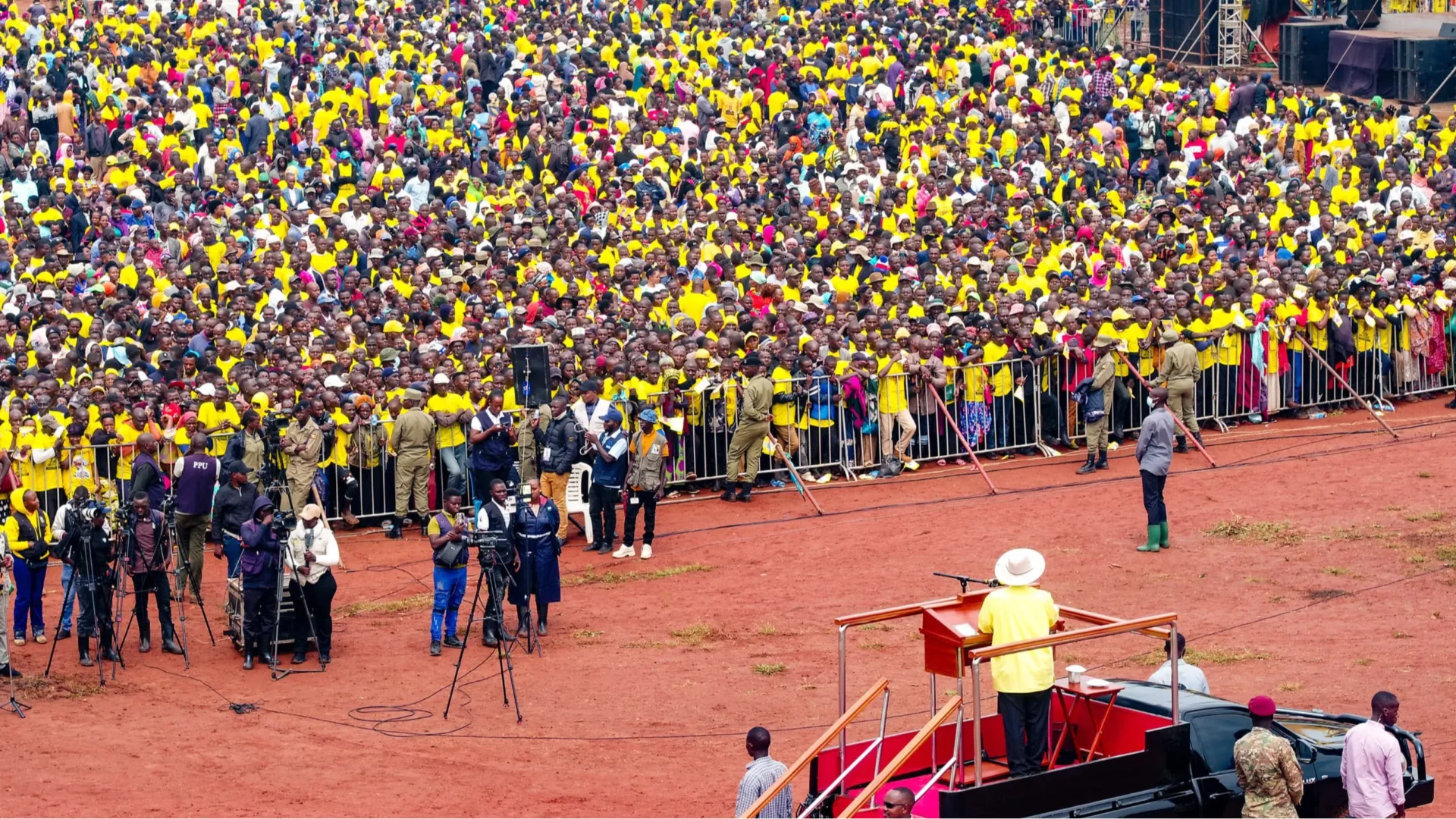
KYANKWANZI, Uganda — President Yoweri Museveni has challenged the residents of Kyankwanzi District to shift their focus toward job creation and wealth generation, asserting that the long-term stability established by the National Resistance Movement (NRM) provides the ideal environment for economic growth.
Speaking to supporters at an NRM mobilization rally in Kyankwanzi on Tuesday, the President underscored that the administration’s primary milestone was the restoration of peace following the systemic conflicts that ravaged the Luweero region and central Uganda during the 1970s and 1980s.
Regarding this era of stability, Museveni noted:
“Uganda has now spent about 40 years without war, and a whole generation has grown up without experiencing conflict.”
He attributed this sustained peace to the rejection of sectarian politics, traditionally rooted in religious, tribal, and gender divisions, which allowed for the development of robust national institutions, including the Uganda Peoples’ Defence Forces (UPDF), the police, and the prison services.
Infrastructure and utilities
The President detailed significant strides in regional development, specifically regarding the expansion of the national power grid and road infrastructure.
He observed that road networks, which previously terminated at Busunju and Mityana, now facilitate trade through Mubende and Fort Portal, reaching as far as the Democratic Republic of Congo border.
In Kyankwanzi specifically, the President reported that:
- Electricity: 18 out of 21 sub-counties are now connected to the national grid.
- Water access: 420 out of 486 villages have access to safe water sources.
Despite these gains, the President emphasized the necessity of expanding irrigation systems to safeguard the agricultural sector.
Also Read: Museveni pledges Shs 85 billion revolving fund for Uganda’s salon and beauty industry
Drawing from his personal experience with a banana plantation in Bushenyi, he highlighted how controlled water usage can maximize output. However, he issued a stern warning against environmental degradation:
“Our swamps can support irrigation if they are well planned, but people should stop encroaching on wetlands.”
The path to economic transformation
While acknowledging the importance of public infrastructure, President Museveni maintained that “development alone is not enough” if it does not translate into wealth at the household level.
To achieve this, he advocated for the “four-acre model” for small-scale landholders—a strategic mix of food crops, cash crops, livestock, poultry, and piggery. For those with more extensive holdings, he encouraged a transition into large-scale commercial farming to bolster the national economy and create local employment.
