


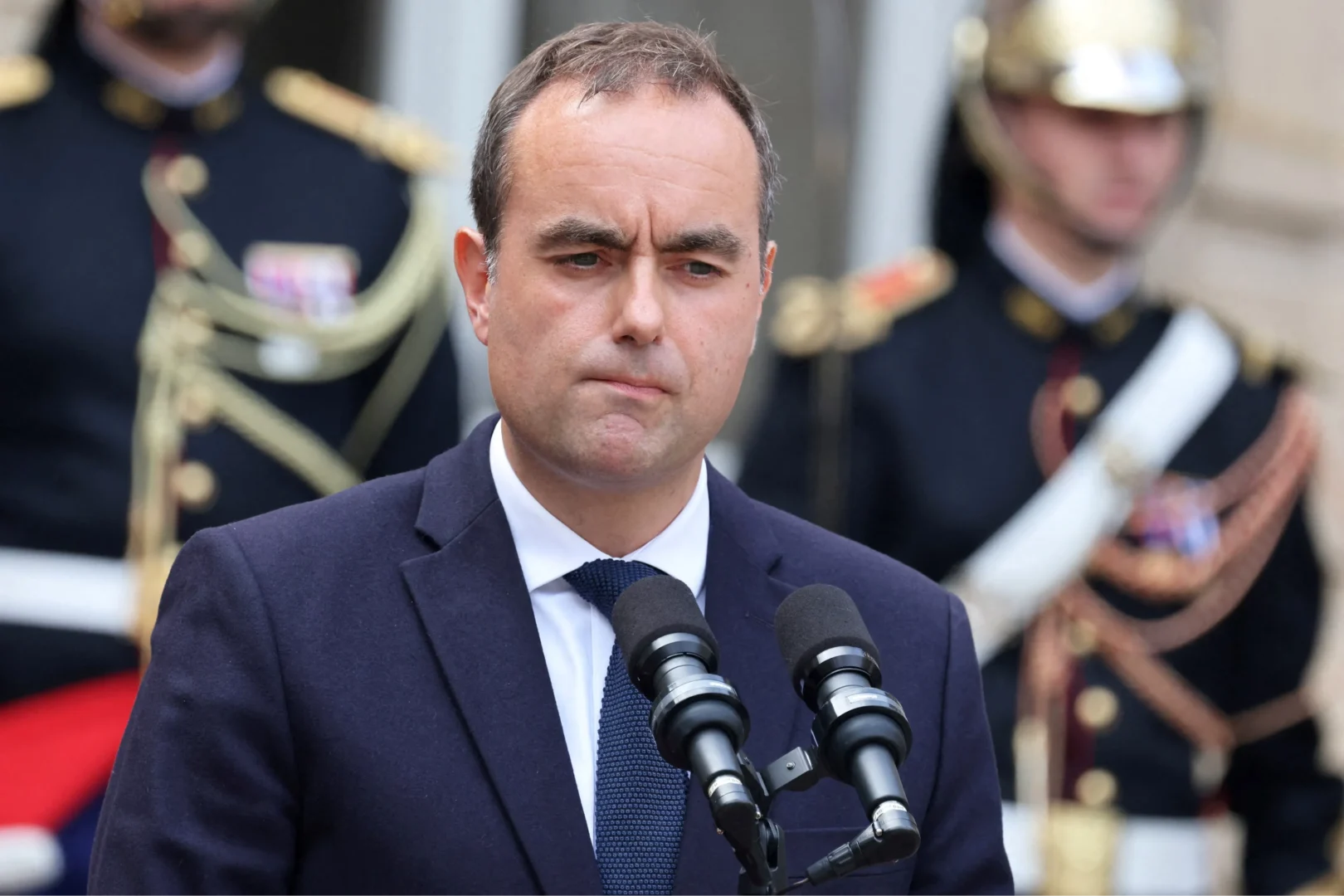
PARIS, France — France’s political instability intensified on Monday 6, October 2025 morning as Prime Minister Sébastien Lecornu resigned, a shocking development that occurred less than 24 hours after his new cabinet was formally unveiled.
The Elysée Palace announced the resignation following a one-hour meeting between Lecornu and President Emmanuel Macron. Lecornu, who was appointed as Prime Minister just 26 days ago following the collapse of the previous government led by François Bayrou, criticized the current political environment.
In his speech outside the Hôtel de Matignon, the official Prime Minister’s residence, which he occupied for under a month, Lecornu pointed to the deep factionalism within the National Assembly.
He sharply criticized the “partisan appetites” of political factions, who he said “are all behaving as if they had an absolute majority.”
Lecornu attributed his short tenure to the unwillingness of parties to compromise, stating: “The conditions were not fulfilled for me to carry on as prime minister.” He elaborated on the breakdown of cooperation: “I was ready for compromise, but all parties wanted the other party to adopt their programmes in their entirety.”
He added that resolving the crisis would not require radical change, but rather a shift in attitude: “It wouldn’t need much for this to work,” saying, however, that parties needed to be more humble and “to cast some egos aside.”
Calls for new elections
The composition of Lecornu’s cabinet, which remained largely unchanged from Bayrou’s, drew fierce cross-party criticism in the National Assembly, where lawmakers immediately threatened to vote the new government down.
This political turmoil has amplified calls across the political spectrum for immediate action, including early elections. Far-right leader Marine Le Pen of the National Rally (RN) was unequivocal in her reaction: “The only wise thing to do now is to hold elections.”
She added: “The joke’s gone on long enough. French people are fed up. Macron has put the country in an extremely difficult position.”
Lecornu, a former armed forces minister, was France’s fifth prime minister in under two years.
Macron’s difficult choices
The responsibility for determining France’s political path now rests with President Macron. He faces three primary constitutional options:
- Appoint another prime minister (seen as the most immediate, natural choice).
- Dissolve the National Assembly and call for new legislative elections.
- Resign (the least likely option, as Macron has consistently stated he will not step down before his term ends in 2027).
Given that Lecornu—regarded as the ultimate Macron loyalist—has now failed, the viability of naming yet another prime minister is questionable.
Although appointing a Socialist could be theoretically considered, such an administration would likely face a quick collapse without cross-party support.
Also Read: Astronomer CEO Andy Byron caught with company’s HR head on Coldplay kiss cam resigns
Analysts suggest the political logic now favors option two: new legislative elections, even if such a contest would likely result in a significant defeat for the pro-Macron center and a major victory for Le Pen’s hard-right faction.
Financial and economic context
France’s political instability dates back to July 2024, when President Macron called for snap parliamentary elections hoping to secure a clear majority.
Instead, the elections resulted in a deeply hung parliament marked by ideologically opposed factions unwilling to cooperate, making it nearly impossible for any government to pass legislation.
This environment has been devastating for fiscal stability. France’s deficit reached 5.8% of its GDP in 2024, and the national debt stands at 114% of GDP—the third highest public debt in the eurozone after Greece and Italy, equivalent to nearly €50,000 per French citizen.
The government of Lecornu’s predecessor, François Bayrou, was ousted after just nine months when parliament refused to endorse an austerity budget aimed at cutting government spending by €44 billion (approximately $51 billion).
The news of Lecornu’s resignation on Monday morning caused a sharp fall in stock prices on the Paris exchange.
