


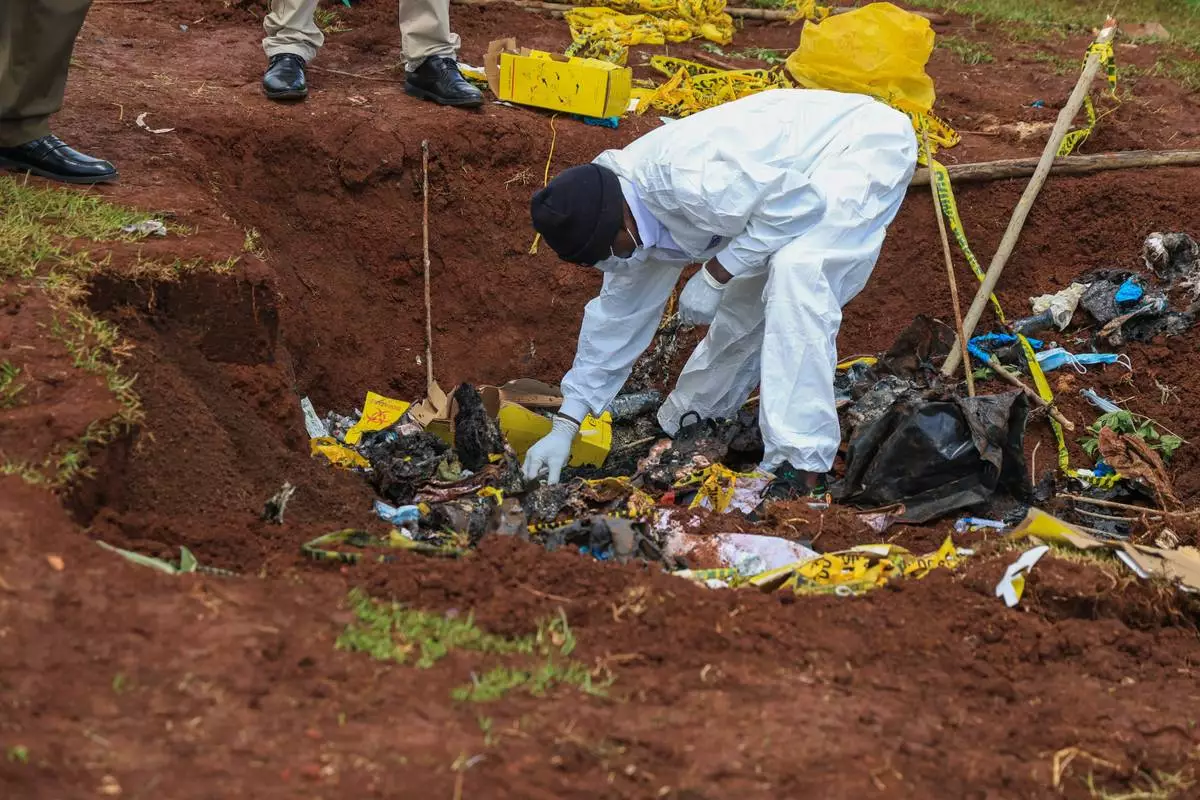
KERICHO, Kenya — Investigations into a mass grave discovered at Makaburini Cemetery in Kericho County have taken a grim turn after post-mortem examinations revealed troubling details about the deaths of children buried at the site.
Forensic pathologists examining the remains of 33 bodies exhumed from the cemetery have established that among the 25 children recovered, several died under circumstances that are now raising urgent questions for investigators.
According to findings presented by lead pathologist Dr Njoroge, four of the children died from head injuries, while 10 were found to have died due to complications linked to premature birth. In two cases, the cause of death could not be determined.
“Prematurity as a cause of death, we found in 10, and then some sort of head injuries we found in 4,” said Njoroge.
The condition of the bodies has complicated the forensic process. Investigators noted that the remains were in varying stages of decomposition, limiting the ability to establish definitive causes of death in some instances.
“They were in various stages of decomposition; only a few are fresh. Others were severely decomposed. In terms of age, some were infants,” he added.
Preliminary identification efforts show that among the children, eight were male and 10 female, while the gender of seven others could not be determined due to the advanced state of decomposition.
The exhumation exercise, which followed the discovery of the graves last Saturday, has drawn significant public attention and prompted calls for accountability over how the bodies ended up buried at the public cemetery without clear documentation.
So far, forensic teams have prioritised examinations of the children’s remains, with autopsies on the eight adult bodies expected to follow.
“Tomorrow, we continue with the adults. We hope to complete the exercise tomorrow,” Njoroge said.
Also Read: 33 bodies, mostly children, exhumed from suspected mass grave in Kericho
Authorities have yet to provide a full account of how the 33 bodies came to be buried at the site, and investigations are ongoing to determine whether there was any criminal wrongdoing, negligence, or systemic failure in the handling of the remains.
The case has raised broader concerns about mortuary management, record-keeping, and oversight within public health and burial systems in Kenya, issues that have surfaced in previous incidents involving unclaimed bodies and undocumented burials.
As forensic analysis continues, attention is now shifting to identification efforts and the possibility of linking the remains to missing persons reports, a process that may prove complex given the condition of the bodies.
For now, the findings mark only the first step in what is likely to be a prolonged investigation into one of the most disturbing discoveries in recent months.
