



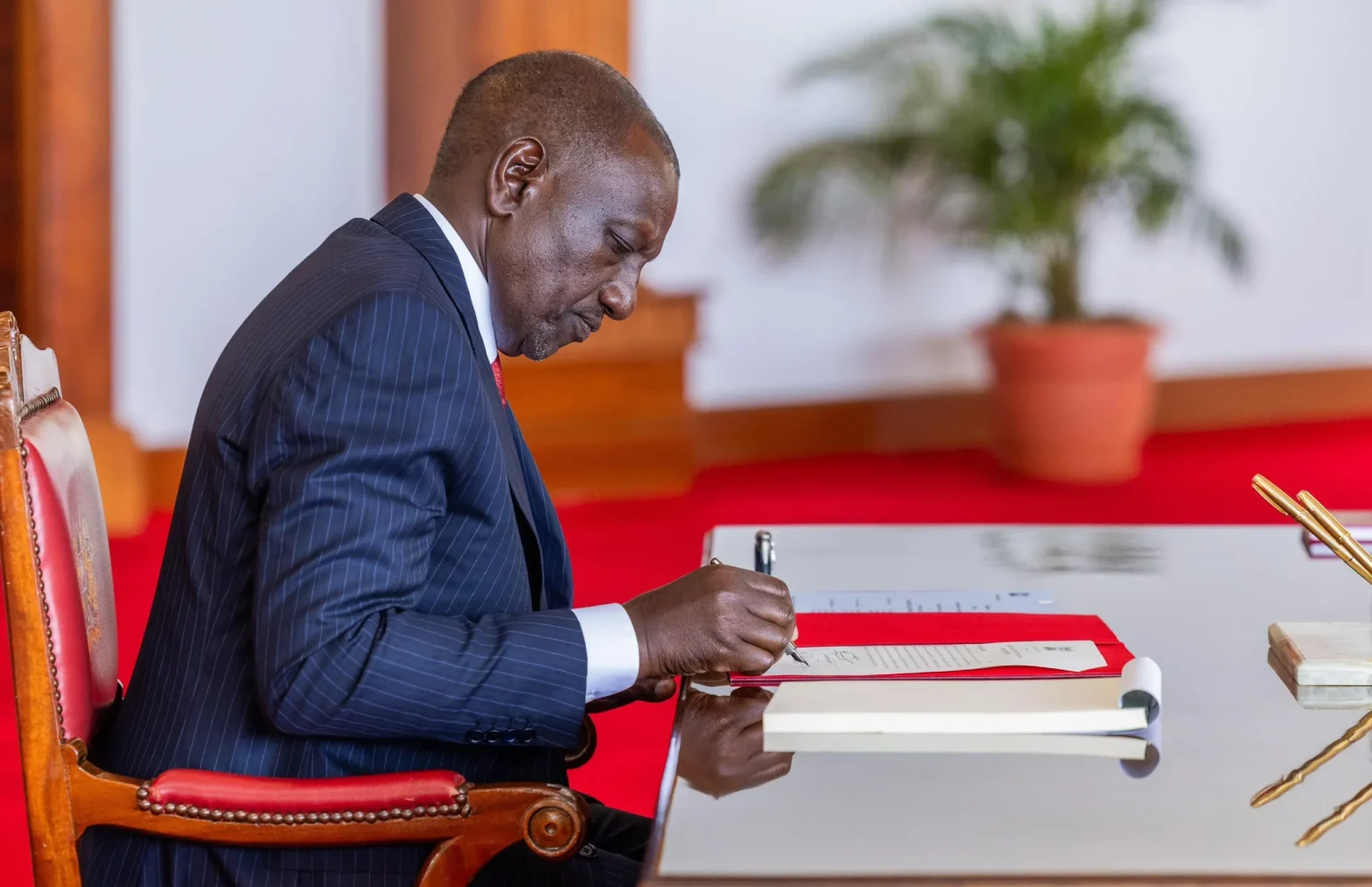
NAIROBI, Kenya — President William Ruto on Friday signed three major pieces of legislation into law at State House Nairobi, marking a significant step in Kenya’s efforts to reform its agricultural sector, expand transport infrastructure financing and strengthen weather services.
The newly enacted laws include the Miscellaneous Fees and Levies (Amendment) Act, 2026, the Coffee Act, 2023 (Mediated Version) and the Meteorology Act, 2023.
The legislation introduces wide-ranging reforms affecting the coffee industry, railway infrastructure financing and the governance of meteorological services.
Coffee Act restructures sector governance
The Coffee Act establishes a new regulatory framework aimed at revitalising Kenya’s coffee sector, one of the country’s key agricultural exports.
Under the law, regulatory and commercial responsibilities currently handled by the Agriculture and Food Authority will be transferred to the Coffee Board of Kenya.
The board will now oversee licensing and regulation of industry players, including the registration of coffee dealers and the issuance of processing permits.
It will also be responsible for implementing policies, strategies and funding mechanisms designed to support the sector.
In addition, the board will collect and maintain industry data, conduct market intelligence surveys and promote Kenyan coffee both locally and internationally.
It will also oversee the use of the Kenya Coffee Mark of Origin and work with the Kenya Bureau of Standards to develop quality standards and codes of practice.
The law also empowers the board to promote regional coffee appellations, support digital marketing initiatives and coordinate Kenya’s participation in international coffee forums.
New coffee research institute
The Act further restructures coffee research by transferring responsibilities from the Coffee Research Institute to a newly established Coffee Research and Training Institute.
The institute will focus on advancing research and training in coffee production, including studies on crop diseases, development of improved varieties and the adoption of modern farming technologies.
Its management will be overseen by a council chaired by a person appointed by the relevant Cabinet Secretary.
Kenya remains among Africa’s leading producers of high-quality Arabica coffee, though production has declined in recent decades due to fluctuating global prices, climate pressures and changing land use patterns.
Railway Levy expanded to fund wider infrastructure
The Miscellaneous Fees and Levies (Amendment) Act expands the scope of the Railway Development Levy, previously used primarily to finance construction of the Standard Gauge Railway.
Under the revised law, the levy will now support a broader range of railway transport infrastructure projects, including rehabilitation of existing rail networks.
The Act establishes a Railway Development Levy Fund, into which all levy collections will be deposited. The move is intended to improve transparency and ensure that the funds are specifically used for railway development.
A new Railway Development Fund Board will manage the fund, with responsibilities that include setting strategic priorities, approving budgets and ensuring efficient use of resources.
Any rehabilitation of railway infrastructure will require approval from both the Treasury Cabinet Secretary and the Transport Cabinet Secretary.
Kenya introduced the Railway Development Levy in 2013 as a charge on imports to help finance major rail projects aimed at modernising the country’s transport network.
New framework for Meteorological services
The Meteorology Act establishes a comprehensive legal framework to regulate weather and climate services in Kenya.
The legislation creates the Kenya Meteorological Service Authority, which will act as the principal technical adviser to both national and county governments on meteorological matters.
The authority will oversee the collection, processing and analysis of meteorological data, issue weather forecasts and advisories, and coordinate early warning systems to reduce disaster risks.
The law also aligns Kenya’s meteorological services with international obligations under the Chicago Convention on International Civil Aviation and standards set by the Intergovernmental Oceanographic Commission of UNESCO.
In addition, the Act establishes a Meteorology Training and Research Directorate, which will serve as the regional training centre accredited by the World Meteorological Organization.
Also Read: High Court rules creation of Ruto’s 21 advisory offices unconstitutional
The directorate will offer professional courses in meteorology, operational hydrology and related atmospheric sciences.
The authority will also register weather stations, coordinate research and development and identify locations for meteorological observation infrastructure.
The law further introduces penalties for actions that interfere with meteorological services and provides intellectual property protection for data, research and innovations produced by the authority.
The signing of the three laws reflects the government’s broader policy agenda aimed at modernising key sectors of the economy, strengthening climate and disaster preparedness, and improving financing mechanisms for major infrastructure projects.
The reforms come as Kenya continues to pursue agricultural value addition, expand transport connectivity and enhance climate resilience in response to increasingly unpredictable weather patterns.