


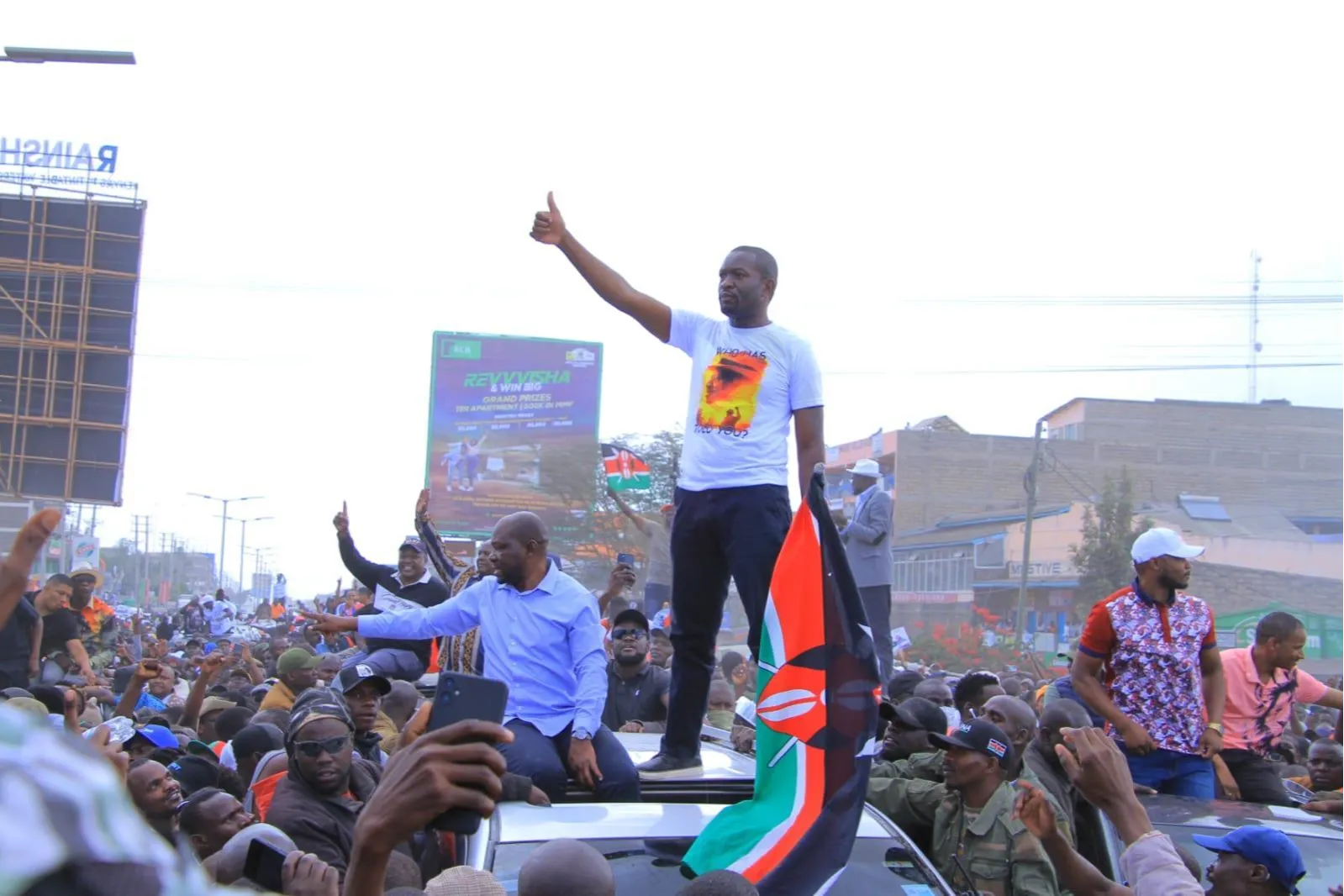
KITENGELA, Kenya — Chaos erupted on Sunday afternoon, 15 February 2026, in Kitengela town after police deployed tear gas to disperse a crowd attending a rally organised by a faction of opposition leaders, escalating existing political tensions ahead of Kenya’s next general elections.
The demonstration, held under the banner of “Linda Mwananchi” (Protect the Citizen), drew hundreds of supporters of Edwin Sifuna, the embattled Secretary-General of the Orange Democratic Movement (ODM).
Protesters waved placards and chanted slogans in support of Sifuna, who was removed from his party position by the ODM National Executive Committee last month, a decision currently being challenged in court.
Several senior opposition figures addressed the crowd, sharply criticising the party’s leadership and accusing it of betraying its founding principles and aligning with the government of William Ruto.
Among those present were Siaya Governor James Orengo and Embakasi East MP Babu Owino, both of whom told supporters that Sifuna remained the legitimate ODM Secretary-General despite his recent ouster.
Rally descends into chaos
Tensions began to rise shortly after the rally commenced in the town centre. Supporters repeatedly called for unity and denounced what they described as undemocratic practices within ODM.
As the crowd swelled, police moved in and fired tear gas canisters in an effort to break up the gathering.
Videos shared on social media showed groups of rally participants coughing, shielding their faces and dispersing as plumes of tear gas drifted through the streets.
Multiple eyewitnesses told Vivid Voice News the situation became disorderly as residents and passers-by were caught up in the dispersal.
The police response sparked immediate debate online and in political circles, with critics accusing security forces of heavy-handedness while others defended the action as necessary to maintain public order.
Political rift within ODM
The protests reflect deepening divisions within ODM, one of Kenya’s oldest opposition parties. The dispute centres on the role and leadership of Edwin Sifuna following his removal as Secretary-General, a decision that has stoked bitter argument among party members.
Opposition leaders at the Kitengela rally accused party leadership, particularly Oburu Odinga, of orchestrating realignments with the ruling coalition led by President Ruto, a move they argue undermines the party’s opposition credibility and betray its core values.
Also Read: Oburu Odinga defends ODM’s decision on Sifuna as party rift deepens
“We are here to protect the integrity of our party,” a rally speaker told supporters, underscoring that “Sifuna remains our SG.”
The faction has continued to plan a series of “Linda Mwananchi” events across key regions, aimed at mobilising grassroots support and countering what they describe as attempts to weaken opposition influence.
Security and political reactions
Government officials did not immediately issue detailed statements on the police action, but authorities typically justify the use of crowd control measures on the grounds of ensuring public safety and preventing political disturbances from escalating into violence.
Some civil liberties advocates condemned the deployment of tear gas, saying it amounted to suppression of peaceful political expression.
“This is political expression, not public disorder,” said a civil rights campaigner, arguing that security forces should adopt restraint when dealing with demonstrations.
Political analysts say the incident underscores widening political fault lines in the run-up to Kenya’s general elections, where opposition unity and strategy will be crucial to mounting a credible challenge to the incumbent government.
The Kitengela incident is likely to intensify discussions on the regulation of political protests, the role of security forces in political gatherings, and the internal coherence of opposition parties.
As the legal challenge to Sifuna’s removal proceeds through the courts, ODM faces a critical test of its ability to manage dissent while maintaining its relevance in Kenya’s increasingly competitive political landscape.
