


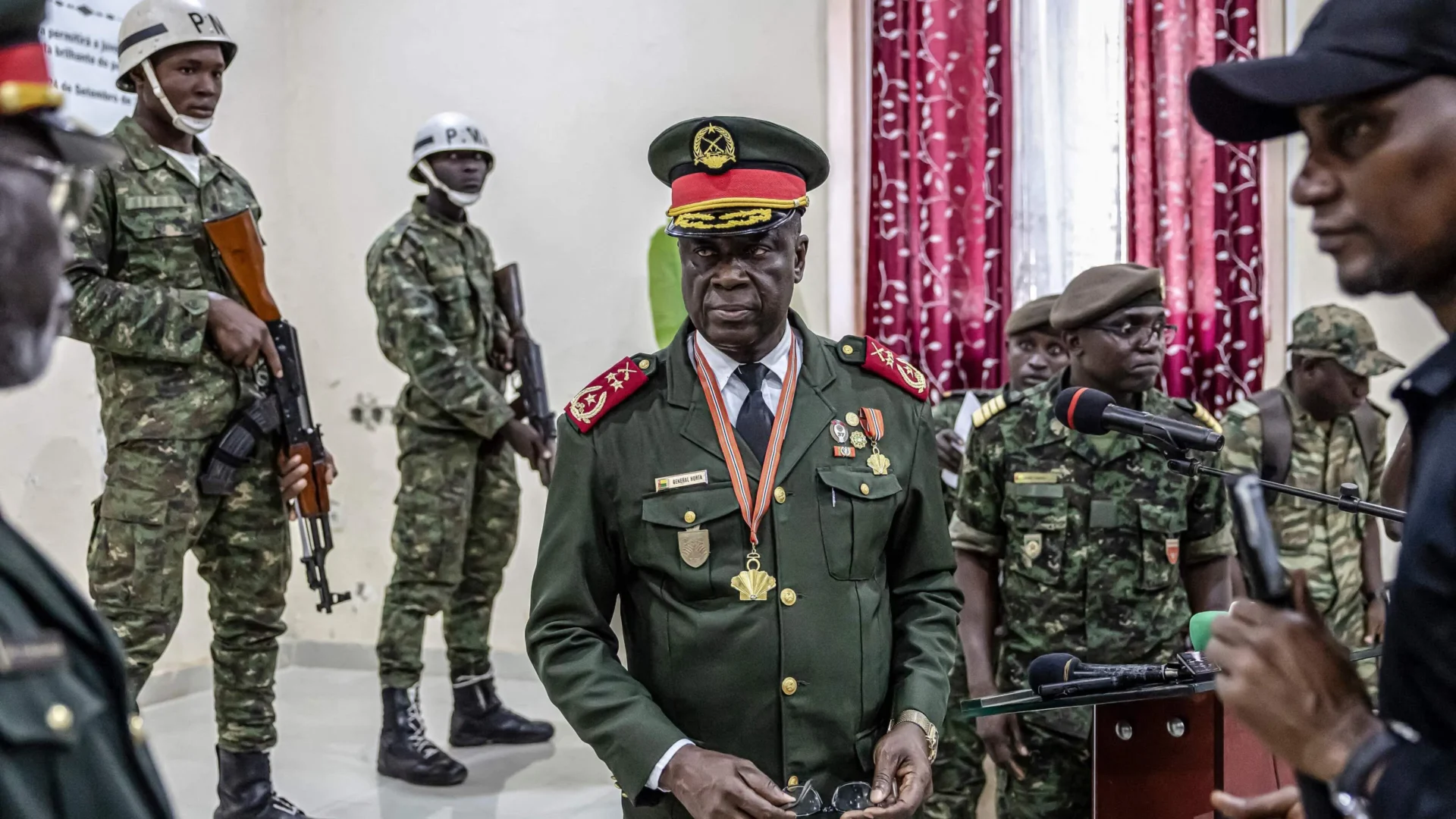
BISSAU, Guinea-Bissau — In a rapid turn of events that has plunged Guinea-Bissau into deeper political uncertainty, Army General Horta N’Tam was sworn in as the country’s transitional head of state on Thursday, just a day after military officers announced they had seized control.
The brief and muted ceremony, held at the army headquarters, saw Gen. N’Tam take the oath of office to lead a one-year transitional government.
This development follows the military’s suspension of the electoral process and the blocking of presidential election results, which were widely expected to be released on Thursday.
Civil society alleges a ‘simulated coup’
While the military claims to be restoring order, a coalition of civil society groups has leveled a startling accusation against deposed President Umaro Sissoco Embaló.
The Popular Front, a prominent civil society coalition, claimed in a statement on Wednesday that the entire military takeover might be a ruse masterminded by Embaló himself.
“This manoeuvre aims to prevent the publication of the electoral results scheduled for tomorrow, November 27,” the Popular Front stated.
Critics allege that Embaló orchestrated a “simulated coup” with the help of loyal military factions to preemptively block the announcement of election results that might confirm his defeat.
Embaló, who has yet to respond to these specific allegations, has faced similar accusations in the past of fabricating crises to justify crackdowns on dissent.
Arrests and detentions
The situation remains fluid and tense. Following reports of gunfire in the capital, Bissau, on Wednesday, President Embaló confirmed his deposition in a phone call to France 24, stating, “I have been deposed.”
However, the military’s net has widened significantly. Government sources told the BBC that key political figures have been detained, including:
- Fernando Dias: The main opposition contender who had claimed victory alongside Embaló.
- Domingos Simões Pereira: A former Prime Minister and Dias’s key backer, who had been disqualified from running.
- Botché Candé: The Interior Minister.
- Gen. Biague Na Ntan: The Army Chief of Staff.
- Gen. Mamadou Touré: The Deputy Army Chief of Staff.
The officers behind the takeover, who have formed the “High Military Command for the Restoration of Order,” claimed on state television that they acted to thwart a plot by unnamed politicians backed by a “well-known drug baron” to destabilize the country.
Also Read: Guinea’s coup leader enters presidential race, breaking promise to cede power to civilians
They also imposed a night-time curfew and temporarily closed borders, though reports indicate borders had reopened by Thursday.
International condemnation
The coup has drawn sharp rebuke from the international community. In a joint statement, election observation missions from the African Union and the West African bloc ECOWAS expressed “deep concern” over the military’s intervention in what had been an orderly process.
“It’s regrettable that this announcement came at a time when the missions had just concluded meeting with the two leading presidential candidates, who assured us of their willingness to accept the will of the people,” the statement read.
Portugal, the former colonial ruler, urged a return to constitutional order, calling on all parties to refrain from violence.
Guinea-Bissau, often labeled a “narco-state” by the UN due to its role as a transit hub for cocaine trafficking, has now witnessed its latest chapter of instability in a history marked by at least nine coups or attempted coups since 1974.
