


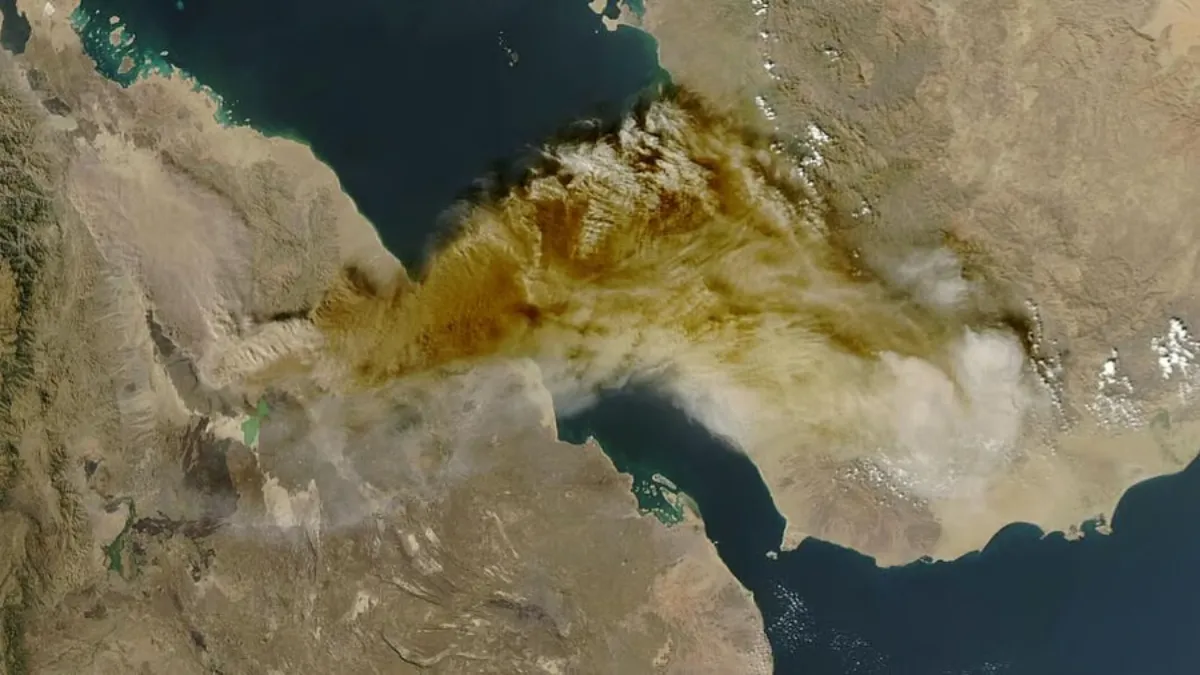
AFAR REGION, Ethiopia — The Hayli Gubbi volcano, located in Ethiopia’s remote Afar region, erupted on Sunday morning, November 23, blanketing nearby villages in ash and dust, according to local media reports.
The eruption is a momentous geological event, marking the first documented activity from Hayli Gubbi in the last 12,000 years, according to data from the Smithsonian Institution’s Global Volcanism Program.
Satellite imagery confirmed a large ash cloud drifting eastward over the Red Sea, rapidly impacting regional airspace.
Flight disruption spreads across Asia
The volcanic plumes quickly led to travel disruptions hundreds of kilometers away. On Tuesday, Indian carriers Air India and Akasa Air announced the cancellation of several flights after ash plumes disrupted aviation operations.
Air India confirmed that it had canceled 11 flights across Monday and Tuesday. This action was taken to conduct precautionary checks on aircraft that had flown over affected locations, following a directive issued by India’s aviation regulator.
Smaller Indian airline Akasa Air also scrapped scheduled flights to Middle East destinations, including Abu Dhabi, Kuwait, and Jeddah, that were slated for the two-day period.
Also Read: Typhoon Kalmaegi leaves at least 114 dead in Philippines, now barrels toward Vietnam
The volcano propelled ash plumes as high as 14 kilometers (8.7 miles) into the atmosphere after the Sunday eruption. By Tuesday, the ash cloud had crossed Yemen and Oman and was tracked over parts of Pakistan and northern India, according to the tracking website Flightradar24.
The India Meteorological Department (IMD) released a statement indicating that the ash cloud is continuing its eastward trajectory toward China but is expected to clear Indian skies by 1400 GMT Tuesday.
Local impact concerns
While local officials cited by media reports confirmed that no casualties had been reported following the eruption, authorities warned of potential long-term risks to the area’s economy.
The large ashfall poses a threat to local livestock owners, as it significantly reduces the available grazing vegetation crucial for their livelihoods.
