





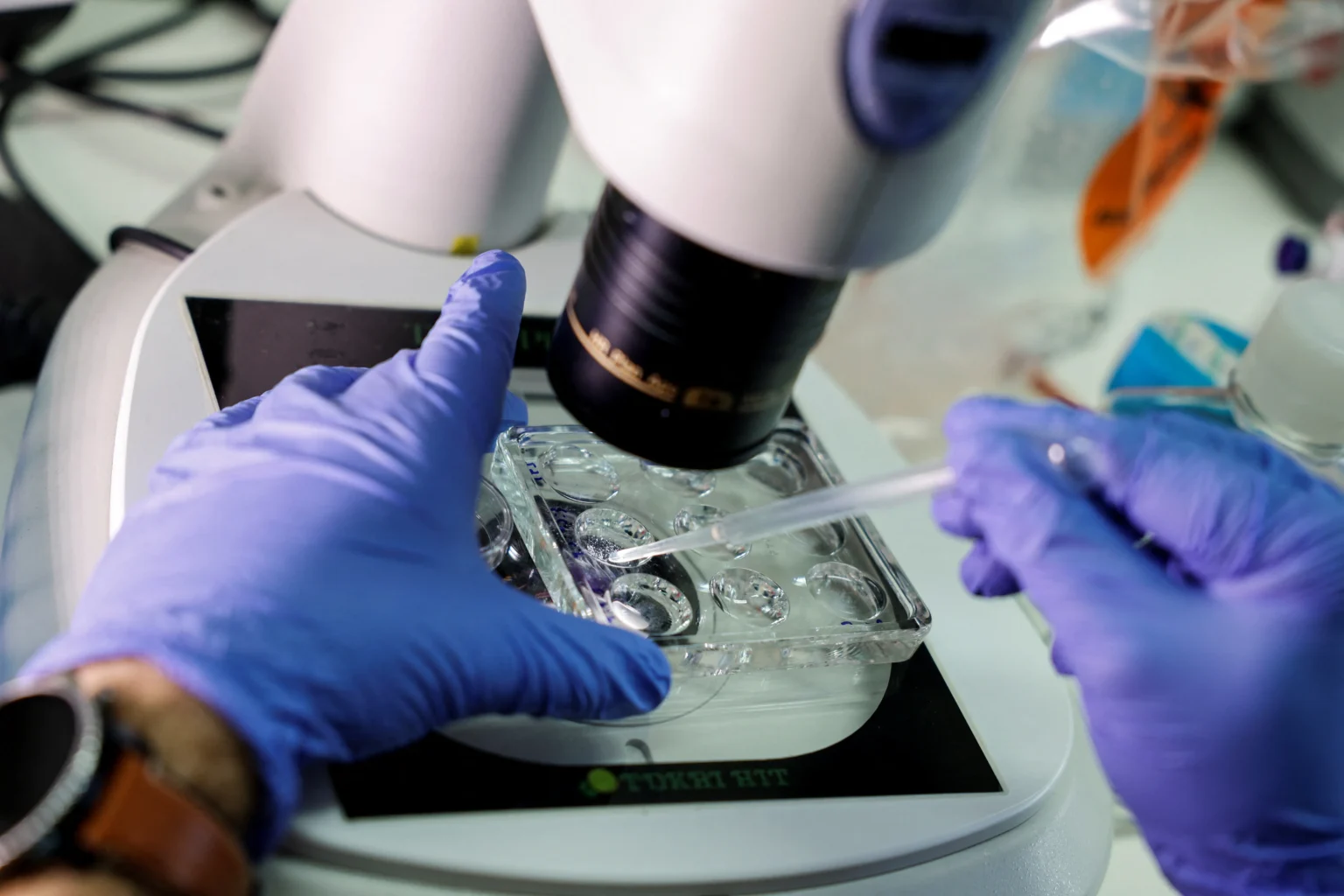
PORTLAND, Oregon — U.S. scientists have achieved a groundbreaking milestone in reproductive science by creating early-stage human embryos from DNA extracted from adult skin cells, which were transformed into pseudo-eggs and then fertilized with sperm, opening potential new pathways for treating infertility and redefining the possibilities of genetic parenthood.
This pioneering technique opens a theoretical pathway to overcome infertility stemming from advanced age or disease by utilizing virtually any somatic cell in the body as the starting point for life.
Crucially, the method also suggests a future where same-sex couples could have a child genetically related to both partners.
The experimental process, developed by a team at the Oregon Health and Science University (OHSU), represents a significant rewrite of the traditional narrative of reproduction. It begins by extracting the nucleus—which contains the complete genetic code—from a donor skin cell. This nucleus is then inserted into a donor egg cell from which the original genetic material has been removed.
Up to this point, the procedure mirrors the cloning technique famously used to create Dolly the Sheep in 1996. However, for a successful pregnancy, the resulting egg must be ready for fertilization, meaning it must contain only half the necessary chromosomes (23 instead of the full 46).
Since the reconstituted egg already holds a full set of 46 chromosomes from the skin cell nucleus, the next critical step involves chemically inducing the egg to expel half of its genetic material—a process the team has termed “mitomeiosis” (a portmanteau of the cell division methods mitosis and meiosis).
The study, published in the journal Nature Communications, documented the creation of 82 functional eggs through this technique. These eggs were subsequently fertilized with sperm, with some progressing to the initial stages of embryonic development, though none were allowed to develop beyond the six-day stage.
Prof. Shoukhrat Mitalipov, director of the OHSU’s Center for Embryonic Cell and Gene Therapy, remarked on the achievement: “We achieved something that was thought to be impossible.”
Refinement and ethical considerations
While groundbreaking, the technique requires extensive refinement, a process that experts estimate could take a decade before clinical application is feasible. The current method is inefficient, achieving only a modest 9% success rate, and suffers from a major flaw: the egg randomly discards chromosomes.
This often results in an uneven distribution (e.g., two copies of one chromosome and none of another), which would inevitably lead to genetic diseases. Furthermore, the chromosomes skip a vital DNA-rearrangement process known as crossing over.
Acknowledging the long path ahead, Prof. Mitalipov, a world-renowned pioneer in the field, stated: “We have to perfect it.” He remains optimistic about the ultimate application of the research: “Eventually, I think that’s where the future will go because there are more and more patients that cannot have children.”
This research is part of a burgeoning field called in vitro gametogenesis (IVG), which aims to generate sperm and eggs outside the human body. The vision is to offer hope to couples currently excluded from traditional IVF due to a lack of viable eggs or sperm, including older women with non-viable eggs, men with low sperm count, or individuals left infertile by cancer treatments.
Redefining parenthood
The technology has profound implications for the definition of genetic parenthood. Since the technique can utilize a man’s skin cells as the source material for the pseudo-egg, it opens the door for same-sex couples to have children genetically related to both partners.
Also Read: Doctor issues warning against kissing bearded men: Here’s why
Prof. Paula Amato, also from OHSU, commented on this potential: “In addition to offering hope for millions of people with infertility due to lack of eggs or sperm, this method would allow for the possibility of same-sex couples to have a child genetically related to both partners.”
Experts in reproductive medicine have lauded the scientific advance while calling for open public discourse. Roger Sturmey, a professor of reproductive medicine at the University of Hull, described the work as “important” and “impressive,” adding: “At the same time, such research reinforces the importance of continued open dialogue with the public about new advances in reproductive research.” He emphasized the need for trust in the process: “Breakthroughs such as this impress upon us the need for robust governance, to ensure accountability and build public trust.”
Prof. Richard Anderson, deputy director of the MRC Centre for Reproductive Health at the University of Edinburgh, also hailed the potential of being able to generate new eggs, calling it “a major advance.” He concluded: “There will be very important safety concerns but this study is a step towards helping many women have their own genetic children.”
