


NAIROBI, Kenya — The African Growth and Opportunity Act (AGOA), a longstanding trade pact that has granted preferential, duty-free access to the U.S. market for thousands of products from qualifying African nations since 2000, is set to terminate as scheduled on Tuesday amidst intense uncertainty.
The expiration, compounded by the introduction of new U.S. tariffs, leaves African industries and their workforce highly vulnerable to competitive pressures and economic disruption.
The end of AGOA risks nullifying two decades of gains, particularly in the textile and apparel sectors. Kenya’s garment industry, for example, has flourished under the agreement, seeing its textile and apparel exports to the U.S. soar from approximately $50 million at AGOA’s inception to around $500 million today. This preferential access allowed manufacturers to compete effectively with major Asian exporters like Bangladesh and Vietnam.
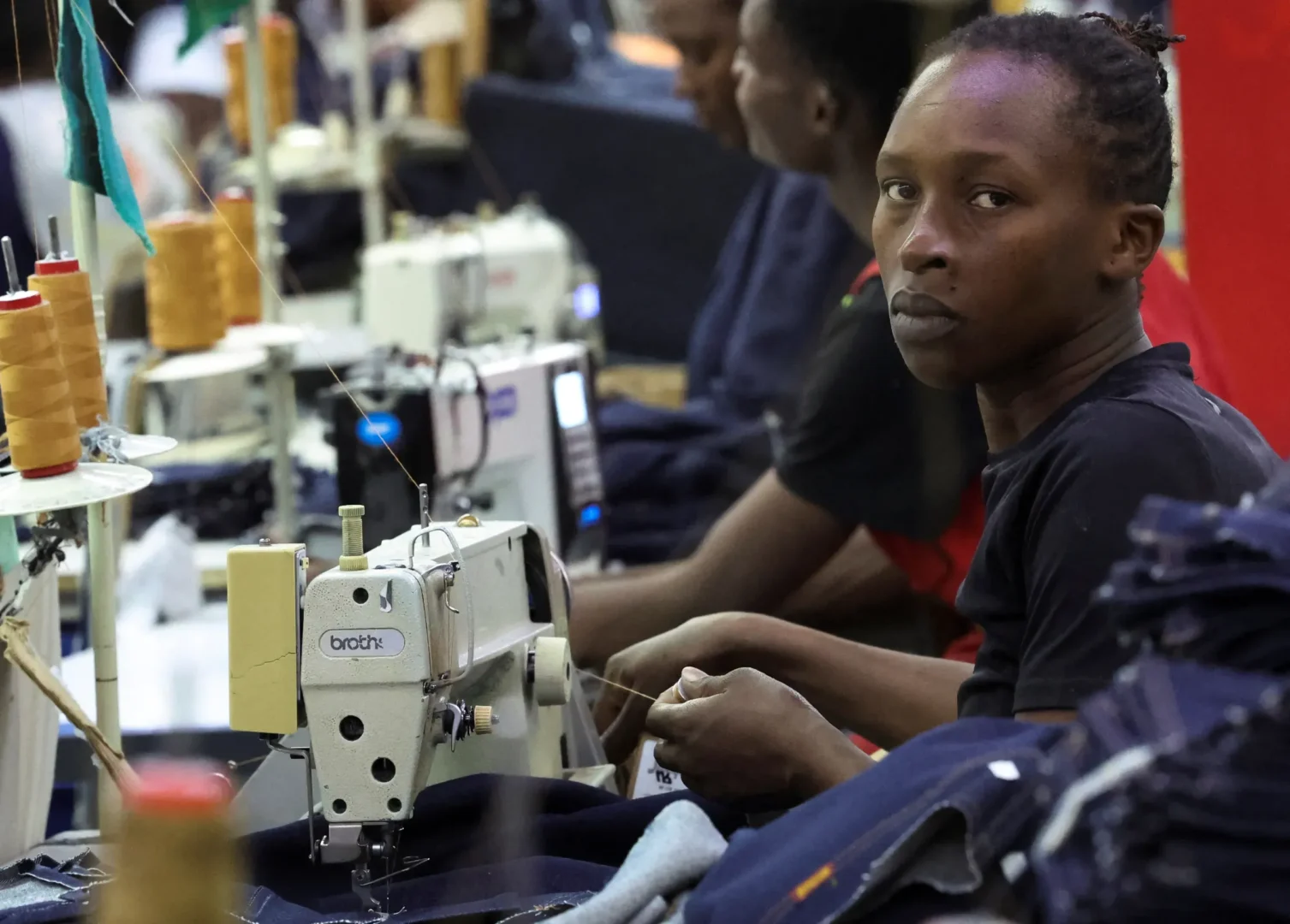
The human cost of the trade deal’s demise is immediate. AGOA-dependent industries across the continent employ an estimated 1.3 million people whose livelihoods are now on the line. In Kenya alone, over 66,000 workers, predominantly women, were employed by now-vulnerable textile and apparel exporters.
The stark reality of a post-AGOA environment is clear to industry leaders. Pankaj Bedi, owner of United Aryan, a Nairobi-based apparel manufacturer that exports Levi’s and Wrangler jeans to the U.S., highlighted the competitive disadvantage: “If AGOA goes away we have zero chance to compete with the Asian countries.” His company has already announced plans to lay off roughly 1,000 employees, or 10% of its workforce, due to the trade uncertainty.
Mr. Bedi, who also serves as the apparel export sub-chair at the Kenya Association of Manufacturers, added: “There is no way we can survive.”
For individual workers, the crisis is existential. Julia Shigadi, a machinist at United Aryan, voiced her deep anxiety: “This has been my bread and butter. I only depend on this job—so if it is gone, it means my life is gone too.”
The tariff challenge and diplomatic push
The expiration comes as African exports face the twin threat of new tariffs announced by the White House in April. While AGOA had shielded major export economies—including Nigerian and Angolan oil, South African autos, and Kenyan clothing—from these new duties, their removal means countries like Kenya must now contend with a 10% tariff on non-AGOA exports.
Kenyan manufacturers will struggle to remain competitive against Asian rivals under the new tariff regime due to persistent challenges like a limited domestic supply chain, higher energy costs, and elevated operating expenses.
African leaders, led by Kenyan President William Ruto, are urgently pushing for a renewal or renegotiation of AGOA, while simultaneously scrambling to secure new bilateral agreements with the U.S.
Also Read: US-China trade talks near as Trump hints at tariff rollback amid global pressure
Speaking at the UN General Assembly in New York last week, President Ruto made a direct appeal: “I will be asking (Trump) for the U.S. to consider seriously renewing and extending AGOA for at least a minimum of five years. It is a platform that connects Africa and the U.S. in a very fundamental way.”
Despite these diplomatic efforts, a high degree of skepticism remains about the U.S. commitment to a continental trade pact. Raphael Obonyo, a public policy expert at UN Habitat, cautioned that African countries must “be alive to the possibility that AGOA won’t be extended, AGOA won’t be remodified, and … America won’t be interested in having a trade pact.”
While the overall macroeconomic effect across Africa from AGOA’s end may be limited, researchers at the German Institute of Development and Sustainability warned that this assumption “likely understate[s] the full impact of new Trump-era tariffs and do[es] not capture the indirect effects like reduced foreign investment, weakened supply chains, rising poverty, or the loss of capacity-building.”
As the deadline passes, countries such as Lesotho and Eswatini, where exports are highly concentrated and deeply reliant on the agreement, are expected to face “notable adverse effects,” further underscoring the critical, immediate challenge now facing the continent’s trade relationship with the U.S.
